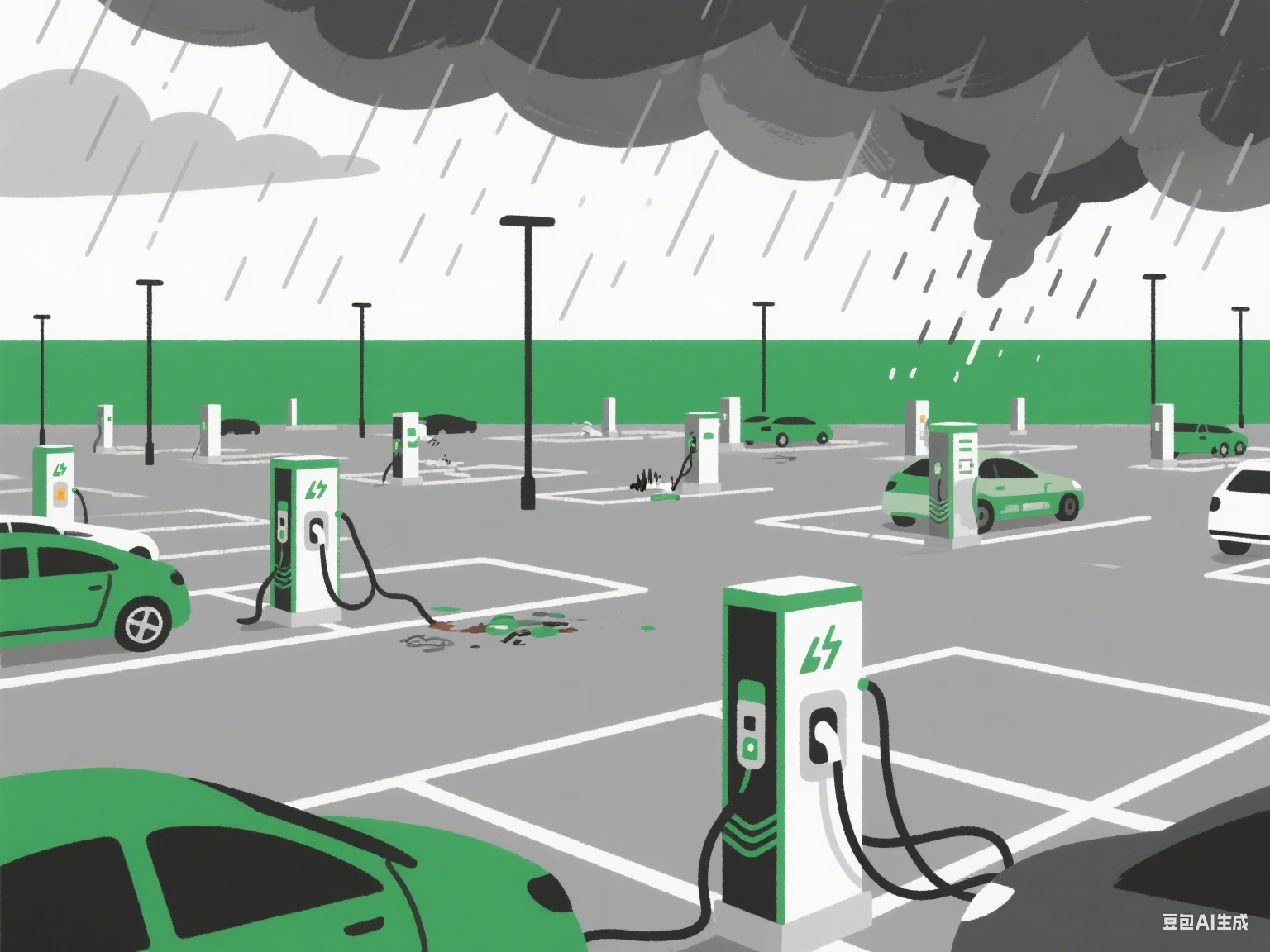
As the global shift toward electric vehicles accelerates, the reliability of public charging infrastructure has emerged as a critical challenge. With forecasts suggesting 145 million EVs on the road by 2030, according to the International Energy Agency, the strain on public charging networks is set to intensify. Unlike private chargers, which exhibit stable usage patterns, public charging stations face erratic load swings—driven by variables like user behavior, weather, and time of day—making accurate forecasting a daunting task. Now, a groundbreaking study introduces a novel approach to predict these fluctuations across multiple stations, promising to enhance grid stability and improve charging efficiency.
The Limitations of Current Forecasting Methods
Traditional EV charging load forecasting has focused primarily on single stations or ignored the complex spatial-temporal relationships between multiple sites. This oversight is problematic: public charging stations, even those geographically distant, often share hidden connections. For example, a surge in activity at a highway rest stop might correlate with reduced usage at a downtown station during rush hour, yet existing models fail to capture such dynamics.
“Public charging loads are inherently more volatile than private ones,” explains a team of researchers behind the new study. “Factors like sudden weather changes, local events, or even social media trends can trigger unexpected spikes. Without accounting for these interdependencies, forecasts remain inaccurate, leading to grid inefficiencies and frustrated users.”
Earlier methods, such as Monte Carlo simulations or basic neural networks, have struggled to handle this complexity. While Monte Carlo models rely on assumptions about driving patterns and charging durations, they often fail to adapt to real-time changes. Data-driven approaches, like long short-term memory (LSTM) networks, excel at time-series predictions but overlook spatial correlations, leaving a gap in multi-station forecasting.
A Leap Forward: Adaptive Spatial-Temporal Graph Neural Networks
The new framework, dubbed Adaptive Spatial-Temporal Graph Convolutional Network (AST-GCN), addresses these limitations by merging graph neural networks (GNNs) with adaptive learning techniques. At its core, the model treats each charging station as a “node” in a dynamic graph, where connections between nodes represent hidden dependencies—regardless of physical distance.
Step 1: Building a Multi-Node Feature Set
The process begins with analyzing historical data from 13 public charging stations (equipped with 93 chargers) over a one-year period. Using a rapid version of the Maximal Information Coefficient (Rapid-MIC), the model identifies key features influencing load, including:
- Historical load data (previous 7 days)
- Temporal factors (weekdays, holidays, months)
- Meteorological variables (temperature, wind speed, precipitation)
This holistic feature set ensures the model accounts for both obvious and subtle influences. For instance, temperature extremes might increase EV usage for climate control, while holidays could shift charging patterns from workplaces to residential areas.
Step 2: Dynamic Graph Generation
Unlike static models that predefine station relationships, AST-GCN uses a Data Adaptive Graph Generation (DAGG) module to evolve connections in real time. This module constructs a “similarity-weighted spatio-temporal graph” where edge weights adjust based on changing correlations. A station near a shopping mall, for example, might develop stronger ties to a suburban station on weekends as shoppers travel between locations.
“Geography isn’t the only factor,” notes the research team. “Two stations miles apart can exhibit similar usage patterns if they serve commuters on the same highway corridor. DAGG captures these nuances, making the model far more flexible than rigid, distance-based approaches.”
Step 3: Enhancing Features with Graph Convolution
Once the graph is constructed, Graph Convolution Layers (GCL) process the data to highlight spatial patterns. By aggregating features from interconnected nodes, GCL amplifies relevant signals—such as a sudden increase in charging demand at a sports stadium affecting nearby stations—and suppresses noise, like isolated equipment malfunctions.
Step 4: Learning Unique Station Patterns
A critical innovation is the Node Adaptive Parameter Learning (NAPL) module. Recognizing that each station has unique usage patterns (e.g., a downtown station serving taxis vs. a suburban station for family cars), NAPL assigns custom parameters to each node. This avoids the “one-size-fits-all” flaw of traditional GNNs, where shared parameters blur distinct behaviors.
Step 5: Predicting Temporal Trends
Finally, Gated Recurrent Unit Layers (GRUL) analyze the time-dependent aspects of the aggregated data, forecasting load fluctuations hours or days ahead. This combination of spatial and temporal learning allows AST-GCN to predict not just how much energy will be used, but where and when.
Results: A New Benchmark in Forecasting Accuracy
Testing the model against real-world data yielded impressive results. Compared to existing methods like support vector regression (SVR) and standalone GRU networks, AST-GCN reduced forecasting errors significantly:
- The Symmetric Mean Absolute Percentage Error (SMAPE) dropped to 12.95%, outperforming SVR (15.19%) and GRU (13.93%).
- The Mean Absolute Error (MAE) fell to 31.72 kW, a marked improvement over noDAGG (33.54 kW) and noNAPL (33.40 kW) variants.
Notably, the model excelled at predicting “worst-case” scenarios—extreme load spikes that most disrupt grid stability. For stations with the highest impact on local grids, AST-GCN reduced peak error metrics by up to 2.73%, a difference that could mean the distinction between grid overload and smooth operation.
“Accuracy in the tails of the distribution matters most,” the researchers emphasize. “A single unforeseen surge can cause transformer failures or blackouts. By narrowing these extremes, we make the grid more resilient.”
Real-World Implications for Grid Operators and EV Users
The benefits of AST-GCN extend beyond technical metrics. For grid operators, precise multi-station forecasts enable proactive load management. Utilities can adjust power distribution, deploy mobile charging units to high-demand areas, or incentivize off-peak charging—reducing costs and carbon emissions.
For EV owners, the impact is tangible. More reliable forecasting means fewer instances of arriving at a station to find all chargers in use or, worse, a network overwhelmed by unanticipated demand. “Imagine planning a road trip and knowing exactly when to stop to avoid crowds,” says an industry analyst. “This technology turns that vision into a reality.”
The model also supports smarter infrastructure planning. By identifying which stations are likely to see increased demand, policymakers can prioritize expansions, ensuring chargers are built where they’re needed most. In urban areas, this could mean adding fast chargers near transit hubs; in rural regions, it might justify upgrading stations along major highways.
Addressing Criticisms and Future Developments
Despite its success, AST-GCN faces potential challenges. Critics point to the model’s complexity, which requires significant computational resources— a barrier for smaller utilities. The research team acknowledges this, noting that optimizations, such as pruning redundant connections in the graph, could reduce processing time without sacrificing accuracy.
Another consideration is data availability. The model’s performance relies on high-quality, long-term data from multiple stations, which may be scarce in regions with nascent EV adoption. To mitigate this, the team is exploring transfer learning techniques, allowing the model to adapt to new locations using limited local data and pre-trained patterns from similar regions.
Looking ahead, the researchers plan to integrate real-time data streams, such as traffic updates and event calendars, to refine predictions further. They also aim to scale the model to hundreds of stations, testing its robustness in densely populated urban centers.
The Road Ahead for EV Charging Forecasting
As EV adoption accelerates, the need for intelligent grid management will only grow. AST-GCN represents a significant step toward a more responsive, user-centric charging ecosystem. By unlocking the hidden relationships between public charging stations, it not only improves forecasting but also paves the way for innovations like dynamic pricing, predictive maintenance, and seamless integration with renewable energy sources.
“EVs are more than just vehicles—they’re distributed energy resources,” says a leading energy economist. “To harness their potential, we need tools that see the big picture. This research does exactly that, turning chaos into order in the evolving landscape of electric mobility.”
In a world racing toward carbon neutrality, breakthroughs like AST-GCN are not just academic achievements—they’re essential building blocks for a sustainable transportation future. As the technology matures, the days of unpredictable charging experiences may soon be a thing of the past, making EVs an even more compelling choice for drivers worldwide.