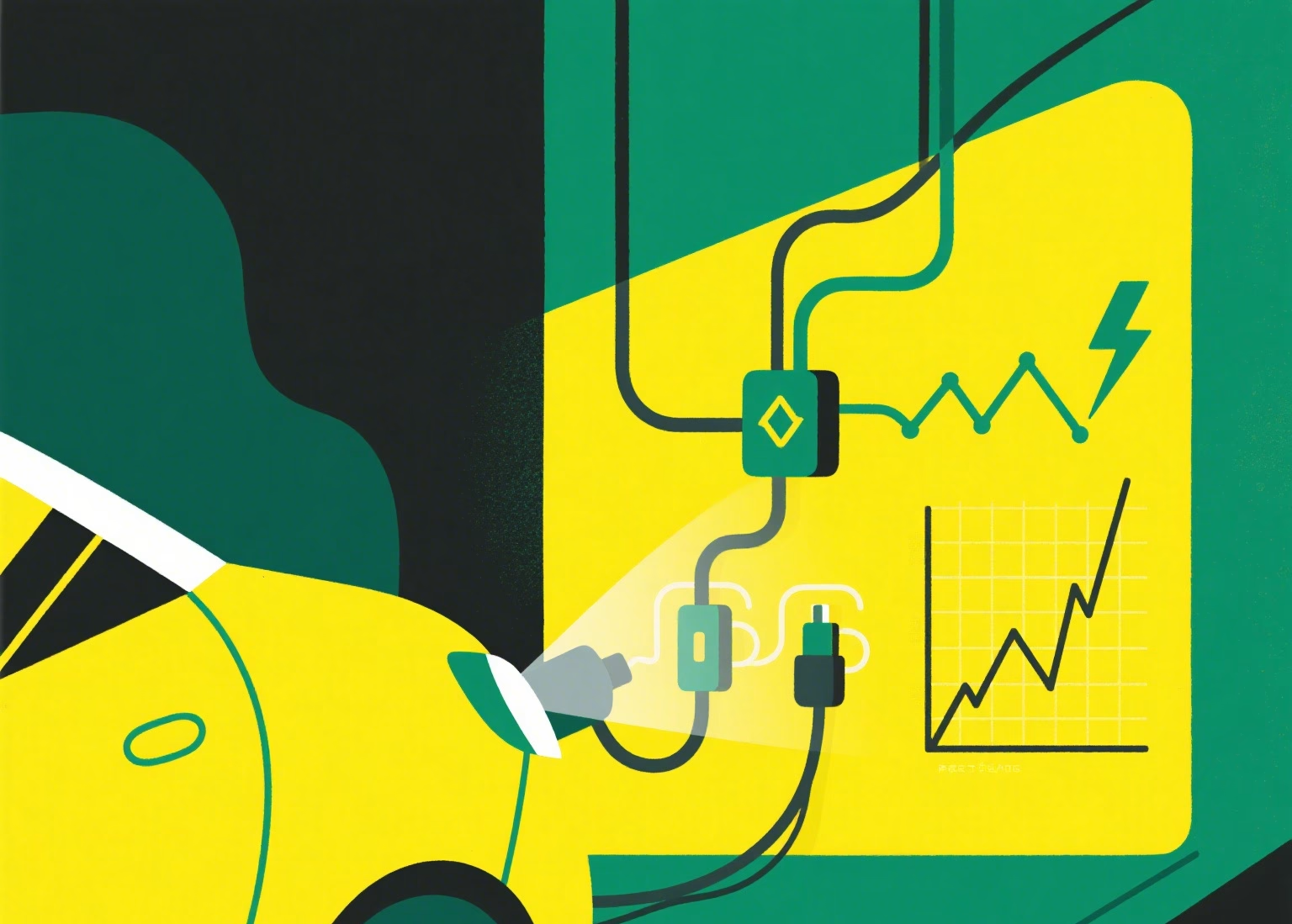
As electric vehicles (EVs) continue their rapid ascent—with China’s new energy vehicle penetration surpassing 50 percent in mid-2024—attention to the intricate systems ensuring their safe operation has never been greater. Among the most vital yet often overlooked components is the pre-charge circuit, a sophisticated mechanism designed to protect high-voltage systems from damaging power surges during startup. Far more than a simple technical detail, this circuitry stands as a cornerstone of EV reliability, preventing costly failures and ensuring driver safety.
The Hidden Danger of High-Voltage Systems
Unlike traditional internal combustion engine vehicles relying on 12-volt electrical architectures, modern EVs incorporate high-voltage systems operating between 400V and 800V. This significant power upgrade enables the performance and range expectations of today’s electric models but introduces unique challenges. The numerous high-voltage components—including motors, inverters, and batteries—function as capacitive loads, meaning they store electrical charge like miniature batteries.
This capacitive nature creates a critical vulnerability: when power is first applied, these components act like short circuits, drawing enormous initial current that can exceed safe operating limits by hundreds of amps. Without protective measures, this inrush would damage sensitive electronics, weld relay contacts together, and potentially create safety hazards for occupants. The pre-charge circuit exists specifically to mitigate this risk, acting as a controlled introduction of power to the vehicle’s high-voltage network.
How Pre-Charge Systems Work
At its core, the pre-charge circuit functions through a carefully orchestrated sequence involving three key components: the main positive relay (K1), main negative relay (K2), and a dedicated pre-charge relay (KP) paired with a current-limiting resistor. This configuration allows the system to gradually charge the vehicle’s high-voltage bus capacitors before full power is applied.
The process unfolds in distinct stages. When an EV driver initiates startup, the system first closes the negative relay (K2), establishing a ground connection. Following a brief delay, the pre-charge relay (KP) activates, routing current through the pre-charge resistor to the high-voltage bus. This resistor limits the charging current, allowing the bus capacitors to charge gradually—a process typically taking 300 to 500 milliseconds.
Only when the voltage across the bus capacitors reaches 95-98 percent of the battery’s voltage does the system close the main positive relay (K1). The pre-charge relay then deactivates, completing the transition to normal operation. This sequence ensures that when the main power path is fully established, there’s minimal voltage difference across the contacts, eliminating damaging arcing and current spikes.
Engineering the Pre-Charge Circuit
Designing an effective pre-charge system requires precise calculation and component selection. The pre-charge resistor, often constructed from nickel-chromium or manganese-copper alloys wrapped around ceramic insulators, must balance multiple factors including resistance value, power handling capability, and physical size.
Resistor values are determined using RC circuit principles, where the goal is to achieve the required voltage rise within the specified time frame while limiting current. Engineers calculate both steady-state power requirements—based on the energy needed to charge the system capacitance—and pulse power handling, which accounts for the brief but intense current flow during pre-charge.
Relays represent another critical selection. These high-voltage DC components must handle the system’s maximum voltage while providing reliable switching at precisely timed intervals. Their contact ratings must exceed the peak currents encountered during both pre-charge and normal operation, with robust construction to withstand thousands of cycles over the vehicle’s lifetime.
When Pre-Charge Systems Fail
Despite careful engineering, pre-charge failures remain among the most common issues during EV development. A case study from a major automaker’s development program illustrates the complexity of these challenges. During testing, multiple vehicles repeatedly failed to complete the pre-charge sequence, triggering high-voltage shutdowns and preventing operation.
Diagnostic data revealed a puzzling pattern: while the battery voltage remained stable at 356V, the high-voltage bus reached only 337V—falling short of the 98 percent threshold required to complete the sequence. Voltage traces showed an unusual oscillation during the pre-charge phase, with the bus voltage climbing to a peak before gradually declining.
Initial investigations ruled out common hardware issues. The pre-charge resistor matched design specifications, and other vehicles using identical components operated correctly. Relay testing showed proper functionality, with no signs of contact wear or sticking that might impede operation. High-voltage load components checked out as well, with no evidence of shorts or excessive leakage.
The breakthrough came when engineers noticed the failures predominantly occurred after AC charging sessions, with the charging cable still connected. Further analysis revealed that the vehicle’s DC/DC converter—responsible for converting high-voltage power to the 12V system—remained active during the pre-charge sequence in this specific scenario.
This continuous operation created a dynamic load on the high-voltage bus during pre-charging. Data showed a 10A current spike from the converter precisely coinciding with the voltage oscillation. While the converter’s 200ms data reporting interval initially masked the timing, higher-resolution voltage measurements confirmed the correlation: the converter’s sudden current demand was pulling down the bus voltage, preventing it from reaching the required threshold.
Solving the Sequence Problem
The solution required a strategic software adjustment rather than hardware modification. Engineers revised the vehicle control unit (VCU) logic to temporarily disable the DC/DC converter during pre-charging, resuming its operation only after the main positive relay had closed successfully.
This seemingly simple change eliminated the voltage fluctuation. Post-modification testing showed smooth voltage climb during pre-charging, with the bus reaching the required 98 percent threshold consistently. The high-voltage shutdown indicator remained off, and vehicles completed the startup sequence reliably even after charging sessions.
The case highlights a critical reality of EV system design: hardware components must work in perfect harmony with software control strategies. While the individual components performed to specification, their interaction under specific conditions created unexpected behavior—a challenge amplified by the increasing complexity of modern automotive systems.
Best Practices in Pre-Charge System Design
Automotive engineers emphasize that robust pre-charge systems require a holistic approach combining careful component selection, thorough testing, and adaptive software strategies. Key considerations include:
- Comprehensive Load Analysis: Identifying all high-voltage components that might draw power during pre-charging, including not just converters but also climate control systems and auxiliary devices.
- Strategic Sequencing: Establishing clear priorities for power activation, ensuring non-essential loads remain inactive until pre-charging completes.
- Robust Monitoring: Implementing high-resolution voltage and current sensing to detect subtle fluctuations that might indicate emerging issues.
- Adaptive Thresholds: Allowing for temporary voltage dips within safe limits while maintaining protection against genuine faults.
- Aging Considerations: Accounting for component degradation over time, with sufficient margin to ensure reliable operation throughout the vehicle’s lifespan.
- Extensive Testing: Validating performance under all operating conditions, including extreme temperatures, low battery states, and post-charging scenarios.
The Evolving Landscape of EV Power Management
As EV voltages rise toward 800V architectures and beyond, pre-charge system importance grows correspondingly. Higher voltages increase arcing risks during relay operation and create greater potential for component damage from inrush currents.
Industry trends point toward more sophisticated pre-charge strategies, including adaptive current limiting that adjusts based on battery state and temperature. Some manufacturers are integrating pre-charge functionality directly into power electronic modules, reducing component count while improving precision.
The growing prevalence of software-defined vehicles enables over-the-air updates to address pre-charge issues, as demonstrated by several manufacturers who have refined their pre-charge algorithms post-launch based on real-world data. This capability represents a significant advantage over traditional automotive development cycles, allowing for continuous improvement throughout a vehicle’s lifecycle.
Ensuring Reliability in the Electric Future
As consumer adoption accelerates, EV reliability becomes increasingly important to mainstream acceptance. Pre-charge system failures, while rarely safety-critical, create significant inconvenience and erode confidence in the technology.
Industry data suggests that well-designed pre-charge systems can reduce high-voltage related warranty claims by as much as 40 percent. For manufacturers navigating the competitive EV landscape, these systems represent an opportunity to differentiate through superior reliability.
Drivers, meanwhile, benefit from this engineering focus through fewer breakdowns and more consistent performance. While the pre-charge circuit may never capture the public imagination like battery range or acceleration figures, its role in ensuring everyday dependability makes it a critical element of the electric vehicle revolution.
As automakers continue pushing the boundaries of electric mobility, the humble pre-charge circuit stands as a testament to the thousands of engineering details that collectively define a vehicle’s quality and reliability. In the transition to sustainable transportation, these behind-the-scenes innovations play an essential role in building consumer trust and driving widespread adoption of cleaner automotive technologies.