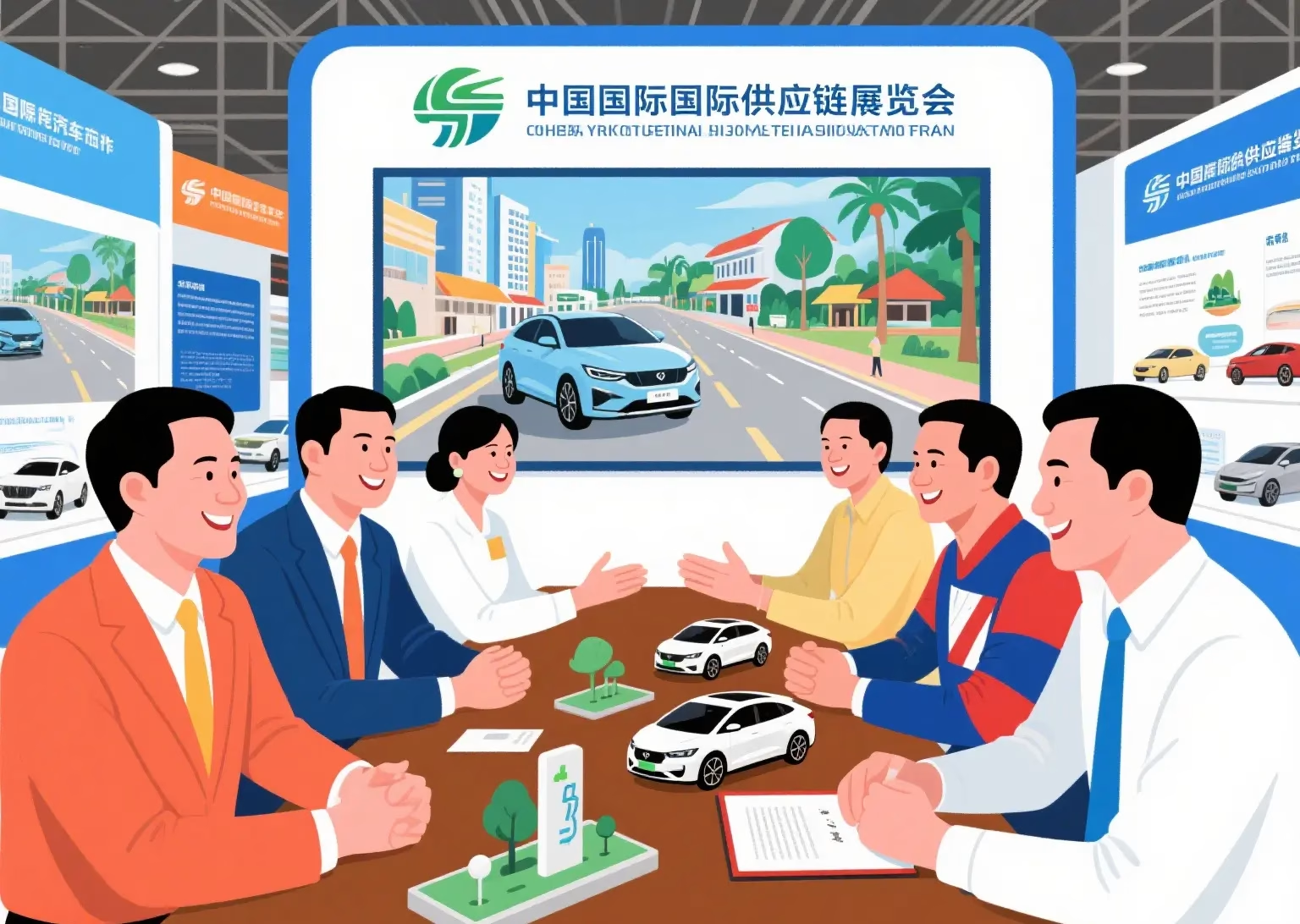
At the 3rd China International Supply Chain Expo, Chinese new energy vehicle (NEV) makers showcased deepened industrial and supply chain cooperation with Southeast Asian nations, highlighting a new path to mutual benefits amid rising global uncertainties.
Industry observers note that as Southeast Asia enhances industrial chain connectivity and investment facilitation, Chinese NEV companies are shifting from “product exports” to “collaborative industrial chain overseas expansion.” By localizing production to meet regional demand and transferring technologies to co-build industries, they are driving growth in Southeast Asia’s automotive sector.
Timely Chain Extension
The Regional Comprehensive Economic Partnership (RCEP) has continued to unlock trade dividends, boosting regional connectivity. Chinese NEV firms, in particular, are eyeing ASEAN nations for their policy support and supply chain strengths, making them ideal destinations to extend industrial chains.
Southeast Asian countries are rolling out friendlier business environments and upgrading supply chain management. Singapore, for instance, uses blockchain to enhance supply chain transparency, while Vietnam simplifies customs procedures and cuts tariffs to support cross-border e-commerce. Malaysia encourages smart manufacturing to reduce costs.
Thailand stands out with advanced 5G networks, expanding data centers, robust logistics, and a strong supply chain network. Its Amata Industrial Estate hosts 650 auto parts factories, providing a ready ecosystem for Chinese NEV chains. “Thailand’s legal framework and industrial clusters make it a regional hub,” notes Narit Therdsathirasak, secretary-general of Thailand’s Board of Investment.
Major Chinese automakers like BYD, Geely, Great Wall, and SAIC have accelerated their presence in the region. “Southeast Asia’s policy incentives, market potential, and geographic advantages attract investments in local production, procurement, and sales,” says Xu Haidong, deputy secretary-general of the China Association of Automobile Manufacturers (CAAM).
Tapping Market Potential
Southeast Asia has emerged as a key target for Chinese NEV exports and investments. CAAM data shows sustained high growth in Chinese NEV exports, fueled by strong competitiveness. As the region’s economy expands, it is transforming from a trade transit hub to a major end market.
By 2030, Southeast Asia’s middle class is projected to reach 472 million, creating a massive consumer base. A report by EY-Parthenon estimates that EV sales in Indonesia, Malaysia, Thailand, and Singapore could surge from $2 billion in 2021 to $80–100 billion by 2035.
Localized production is key to capturing this potential. BYD’s Thai plant, operational since July 2023, covers full manufacturing processes from stamping to assembly. SAIC-GM-Wuling’s 3 millionth global NEV rolled off its Indonesian production line in May. These moves help cut costs and align products with local preferences.
In Indonesia, Chinese brands dominate over 90% of pure EV wholesale sales in the first half of this year, with volumes jumping 267% year-on-year. In Thailand, four of the top five best-selling EVs last year were Chinese. In Malaysia, Great Wall Motor’s locally assembled Haval H6 ranks second in the hybrid SUV segment.
“The combination of China’s leadership in EV R&D, battery innovation, and infrastructure, with ASEAN’s growing demand for green mobility, creates strong complementarity,” says Edmund Araga, president of the Electric Vehicle Association of the Philippines.
Building Integrated Ecosystems
Southeast Asia is fast becoming a hub for industrial clustering, with Chinese NEV firms exporting not just products but entire ecosystems—including technological innovation, supply chain support, talent development, and efficient management.
“China’s NEV sector leads in scale, systemization, and rapid iteration, making it a global innovation driver,” Xu Haidong notes. Bringing this ecosystem to Southeast Asia helps local industries adopt smart cockpits and automated parking technologies at lower costs, boosting modernization and global competitiveness.
Collaborations are deepening across the region. BYD’s Thai plant introduced advanced flexible production, upgrading local manufacturing capabilities, with plans to add plug-in hybrid technologies. In Malaysia, Geely revitalized national brand Proton through strategic investment and co-developed the Tanjung Malim High-Tech Automotive Valley, aiming to make it an ASEAN automotive hub.
As more Chinese NEVs hit Southeast Asian roads, these industrial and supply chain partnerships are fostering a deeply integrated, win-win ecosystem—driving sustainable growth for all stakeholders.