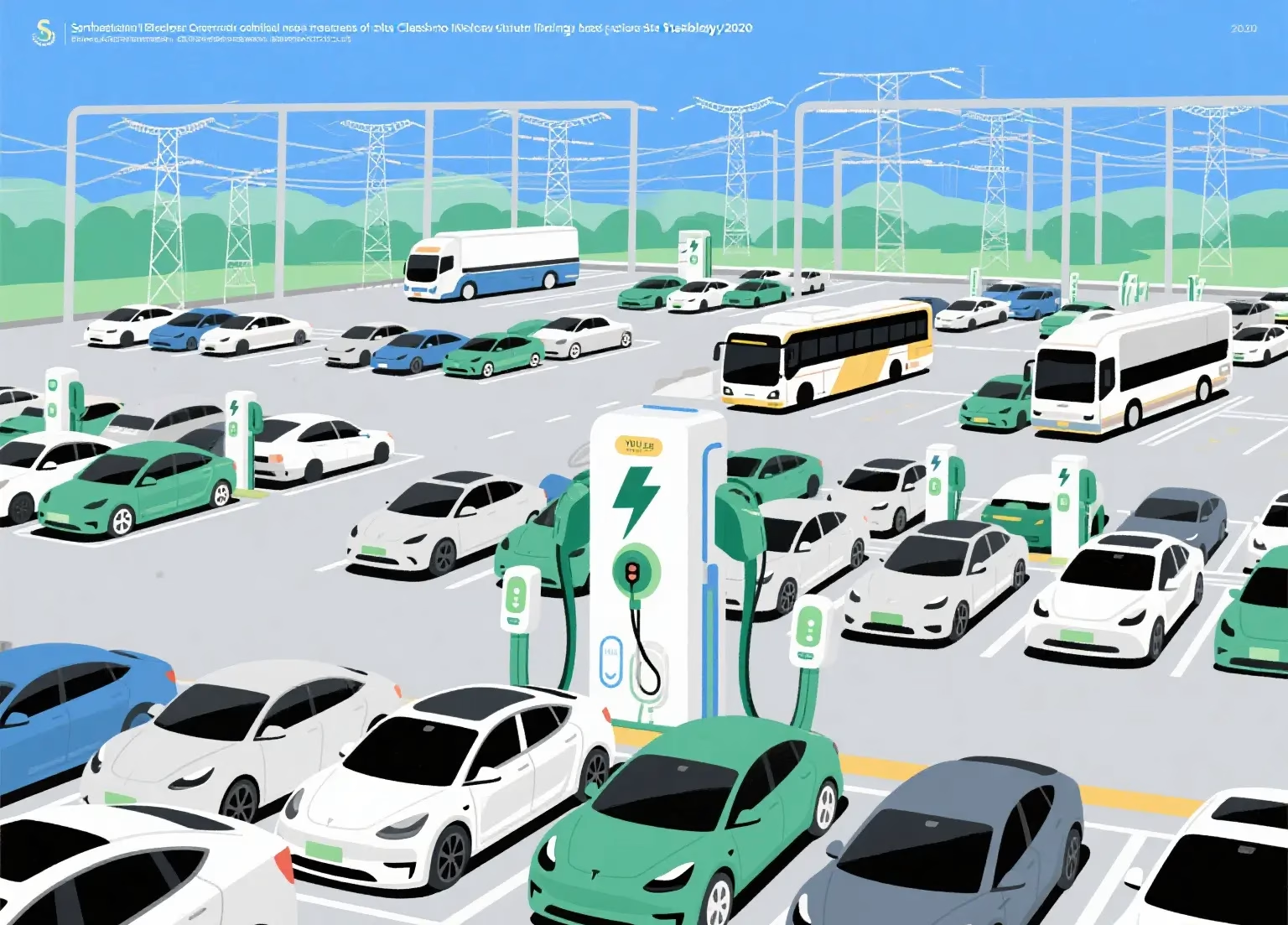
As the global shift toward electric vehicles (EVs) accelerates, understanding the cumulative impact of large-scale EV charging on power grids has become a pressing concern for energy planners, policymakers, and industry stakeholders. A new study published in Southern Energy Construction offers a comprehensive framework for calculating EV cluster charging loads, shedding light on how different vehicle types—from private cars to buses and logistics vehicles—will strain power systems by 2030. The research, led by YOU Lei, JIN Xiaoming, and LIU Yun from China Energy Engineering Group Guangdong Electric Power Design Institute Co., Ltd., introduces a data-driven approach that could revolutionize grid management strategies in the era of mass electrification.
The Urgency of Accurate EV Charging Load Forecasting
The rise of EVs is undeniable. By 2022, China alone saw 6.887 million new energy vehicle sales, with EVs accounting for 5.365 million of those, representing a 25.6% market share—a clear indicator of the sector’s rapid growth. While this transition promises significant environmental benefits, it also presents a unique challenge: the unpredictable and variable nature of EV charging loads. Unlike traditional stationary loads, EVs introduce dynamic patterns of energy consumption, driven by diverse usage behaviors across vehicle types. If left unmanaged, these loads could exacerbate peak demand, widen grid load gaps, and compromise the stability of power systems.
“Large-scale EV adoption is a double-edged sword,” explains the research team. “While it reduces carbon emissions, the aggregated charging demand of millions of vehicles—each with distinct usage patterns—threatens to create ‘peak-on-peak’ scenarios, where EV charging coincides with existing high-demand periods. Accurately modeling these loads is critical to ensuring grid resilience.”
Previous studies have attempted to address this issue, often relying on Monte Carlo simulation methods to model user behavior. However, these efforts have been limited by narrow vehicle type classifications—typically focusing only on private cars, taxis, and buses—and subjective probability fitting lacking robust statistical foundations. As new EV categories emerge, such as ride-hailing vehicles and electric logistics trucks, a more inclusive and data-backed approach is necessary.
A Novel Framework: Classifying EVs and Modeling Behavior
The research introduces a refined methodology that categorizes EVs into six distinct types based on usage: private cars, buses, taxis, ride-hailing vehicles, official vehicles, and logistics vehicles. For each category, the team analyzed real-world data to extract typical battery performance parameters and establish probabilistic models that capture the randomness of travel and charging behaviors. By integrating forecasts of future EV adoption rates, the model simulates daily charging schedules for individual vehicles and aggregates these to compute total cluster loads—a approach that offers unprecedented granularity.
“Our method goes beyond one-size-fits-all modeling,” notes the lead author. “Each vehicle type has unique patterns: a private car might charge overnight at home, while a taxi prioritizes quick charges during downtime to maximize operational hours. By accounting for these differences, we can generate far more accurate load forecasts.”
Key behavioral insights for each vehicle type emerged from the analysis:
- Buses: Operate on fixed schedules, with primary charging occurring overnight after 19:00. Due to long daily mileage (50–300 km), some buses require midday fast charging to meet demand. They utilize fast chargers (90 kW) to minimize downtime.
- Private Cars: Charge primarily at home (80%) or work (20%), with home charging peaking between 18:00–22:00 and workplace charging between 8:00–10:00. Most use slow chargers (7 kW), with only 15% opting for fast charging.
- Taxis: Operate in 12-hour shifts, with charging spread across four daily windows (0:00–8:00, 8:00–15:00, 15:00–19:00, 19:00–24:00). They rely almost exclusively on fast charging (90 kW) and typically charge twice daily to maintain operational efficiency.
- Ride-hailing Vehicles: Similar to taxis in daily mileage (50–400 km) but with later end times (often after 21:00). They use a mix of fast (75%) and slow (25%) charging.
- Official Vehicles: Charge primarily at workplaces after 16:00, using slow chargers (7 kW) due to predictable, shorter daily trips.
- Logistics Vehicles: Operate during daytime hours (4:00–20:00) with charging occurring post-shift (19:00–22:00). Over 70% use fast charging, reflecting the need to minimize downtime for delivery schedules.
By quantifying these behaviors, the model assigns key parameters such as battery capacity, energy consumption per kilometer, charging power, and efficiency (consistently set at 95% for all types). This granularity allows for precise simulation of daily charging profiles.
2030 Simulation: A Case Study in Southern China
To validate the methodology, the researchers applied it to a hypothetical 2030 scenario in a southern Chinese province, forecasting EV adoption rates across all six categories. The projections, based on linear regression analysis of 2020 data and 2025 estimates, suggest significant growth: private EVs could reach 2–3 million, logistics vehicles 316,000, and ride-hailing vehicles 160,000, among other categories.
The simulation yielded striking results. By aggregating individual vehicle loads, the study identified critical patterns in cluster charging behavior:
- Peak Times: The overall EV cluster experiences its highest demand between 19:00–23:00, with a peak load of 10.0927 GW—equivalent to the output of several large power plants. A secondary, smaller peak occurs between 8:00–10:00, accounting for only 18–20% of the nighttime peak, driven primarily by private cars charging at work.
- Vehicle Type Impact: Buses emerged as the single largest contributors to peak loads, reaching 4,639.5 MW—far exceeding private cars, whose peak load (3,210.4 MW) represents less than 70% of buses. Taxis, despite their high numbers, showed the lowest peak loads due to dispersed charging times and fast charging efficiency.
- Private Car Sensitivity: The model tested two scenarios for private EV adoption (2 million vs. 3 million). The high-adoption scenario increased private car peak loads by ~50%, highlighting the significant role private vehicles will play as their numbers grow. If current trends continue, private EVs could eventually surpass buses as the dominant source of charging demand.
“These findings underscore the need for targeted grid planning,” the researchers emphasize. “Buses, with their high individual power consumption and synchronized charging times, present immediate challenges. However, the sheer volume of private cars, as their numbers swell, will require long-term strategies to manage their aggregated impact.”
Implications for Grid Planning and Policy
The study’s outcomes have far-reaching implications for energy infrastructure development. By pinpointing peak times and dominant vehicle types, grid operators can optimize charging station placement, upgrade distribution networks in high-demand areas, and implement demand-response programs to shift charging to off-peak hours.
For policymakers, the data supports incentives for smart charging—such as time-of-use pricing to encourage overnight charging for private cars or subsidizing fast-charging infrastructure for buses and logistics vehicles. Additionally, the model can inform renewable energy integration, as surplus solar or wind power during daytime hours could be directed toward EV charging, reducing reliance on fossil fuels.
“The key is flexibility,” the authors argue. “Grid systems must evolve from passive distributors to active managers of demand. Our model provides the tools to anticipate where and when loads will surge, enabling proactive rather than reactive planning.”
Advancing the Field: Methodology and Future Research
What distinguishes this research is its incorporation of understudied vehicle types such as ride-hailing and logistics vehicles, which are undergoing rapid electrification yet frequently neglected in load modeling. By accounting for their distinct usage patterns—including ride-hailing vehicles’ late-night charging tendencies and logistics fleets’ midday top-up requirements—the framework provides a more comprehensive perspective on future electricity demand.
The methodology also addresses limitations of previous approaches by grounding probability models in empirical data, such as daily mileage distributions from real-world EV fleets and charging pattern surveys. This reduces subjectivity and enhances the model’s reliability for practical applications.
Looking ahead, the team plans to refine the model by incorporating real-time traffic data and weather impacts on EV range, further improving accuracy. They also aim to explore regional variations, as charging behaviors in urban vs. rural areas may differ significantly.
Conclusion
As the world races toward decarbonization, understanding the interplay between EV adoption and grid stability is paramount. This study provides a robust, scalable framework for forecasting EV cluster charging loads, offering actionable insights for planners, utilities, and policymakers. By highlighting the dominant role of buses in near-term peak loads and the growing influence of private cars, it charts a clear path for infrastructure investment and demand management.
In an era where energy systems must balance sustainability with reliability, such research is not merely academic—it is essential to building the resilient grids of tomorrow.
Authors: YOU Lei, JIN Xiaoming, LIU Yun
Affiliation: China Energy Engineering Group Guangdong Electric Power Design Institute Co., Ltd., Guangzhou 510663, Guangdong, China
Journal: Southern Energy Construction
DOI: 10.16516/j.ceec.2024.5.17