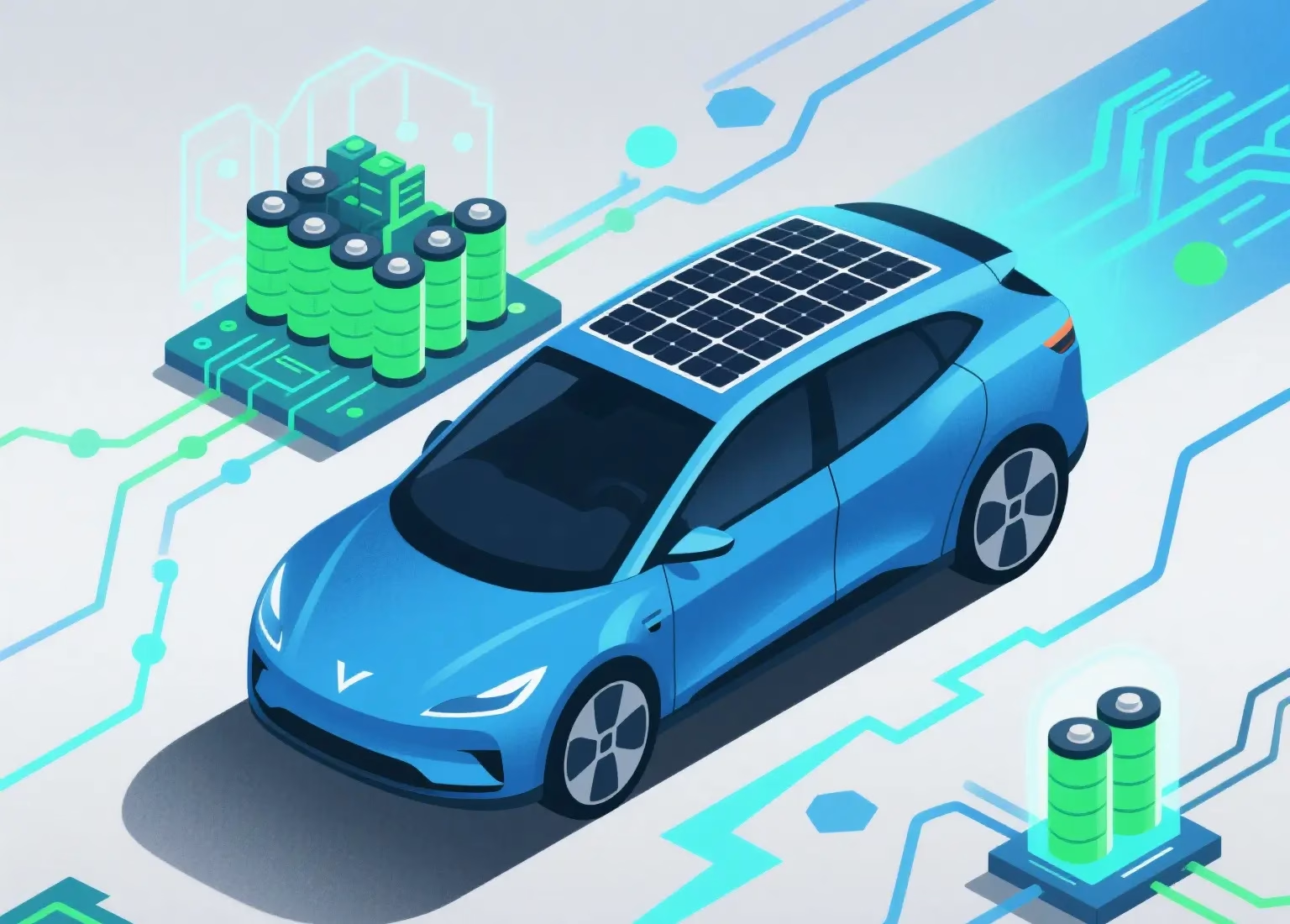
As the global automotive industry accelerates its shift toward electrification, the demand for more efficient energy management systems in pure electric vehicles (PEVs) has never been more critical. A recent study published in the Journal of Guangxi University of Science and Technology sheds new light on optimizing low-voltage power supply management, offering promising solutions to reduce energy consumption and enhance battery charging efficiency—key factors in improving overall vehicle performance and user experience.
The research, led by Peng Fan and Luo Wenguang from the School of Automation and the Guangxi Key Laboratory of Automobile Components and Vehicle Technology at Guangxi University of Science and Technology, delves into the complexities of managing low-voltage power systems in PEVs. With the proliferation of in-vehicle electrical devices, from safety-critical components to comfort and entertainment systems, the energy consumed by these devices now constitutes a significant portion of a vehicle’s total energy usage. This reality has underscored the need for sophisticated strategies to manage low-voltage power effectively, ensuring both reliability and efficiency.
The Critical Role of Low-Voltage Power Management
Low-voltage power supply systems in PEVs are responsible for powering a wide array of essential components, including safety systems (such as braking and lighting), driving-related electronics (like steering assistance), and user-centric features (air conditioning, infotainment). Unlike high-voltage systems that power the vehicle’s propulsion, low-voltage systems rely on auxiliary batteries—typically 12V lithium-ion batteries—to maintain continuous operation of these devices. However, inefficient management of these systems can lead to excessive energy drain, reduced battery life, and even operational failures, such as an inability to start the vehicle due to a depleted low-voltage battery.
“Traditional approaches to low-voltage power management often fail to account for the dynamic nature of vehicle operations and varying energy demands across different driving conditions,” explains Peng Fan. “Our goal was to develop a strategy that not only ensures the reliability of critical systems but also minimizes energy waste, thereby extending the vehicle’s range and improving battery longevity.”
A Multifaceted Approach: Load Classification and Genetic Algorithm Optimization
The study introduces a two-pronged strategy to address these challenges: first, a detailed classification of vehicle loads based on their functional importance, and second, the application of a genetic algorithm to optimize the state of charge (SOC) thresholds that govern energy distribution.
Load Classification: Prioritizing Critical Systems
The researchers categorized vehicle loads into four distinct classes: safety-critical, driving-related, comfort, and entertainment. Safety-critical loads—such as braking systems, airbags, and essential lighting—are prioritized to ensure vehicle and passenger safety under all conditions. Driving-related loads, including power steering and traction control, directly impact vehicle performance, while comfort and entertainment systems (e.g., air conditioning, audio) enhance user experience but can be scaled back when energy is scarce.
To account for varying energy demands across seasons and driving scenarios, the team introduced weighted coefficients to calculate power consumption under extreme conditions, such as winter snowstorms and summer rainstorms—situations where loads like heaters, defrosters, and wipers are heavily utilized. This classification allows the system to dynamically adjust power allocation based on real-time conditions, ensuring that critical systems receive priority during high-demand periods.
Genetic Algorithm: Fine-Tuning SOC Thresholds
A key innovation in the study is the use of a genetic algorithm to optimize SOC thresholds for low-voltage batteries. SOC, which measures the remaining charge in a battery relative to its total capacity, is a critical parameter in determining when to conserve energy or initiate charging. By optimizing these thresholds, the researchers aimed to minimize energy consumption while maintaining sufficient power for essential functions.
The genetic algorithm, a computational method inspired by natural selection, was used to iteratively refine four SOC thresholds corresponding to different safety levels. These thresholds dictate when non-essential loads (e.g., entertainment systems) are gradually deactivated to preserve energy. After 300 iterations, the algorithm identified optimal thresholds that balanced energy conservation with operational reliability.
“Genetic algorithms are particularly effective here because they can navigate complex, multi-variable problems to find near-optimal solutions,” notes Luo Wenguang. “By optimizing SOC thresholds, we ensure that energy is allocated where it is most needed, reducing unnecessary drain on the battery.”
Revolutionizing Charging: A SOC-Based Four-Stage Constant Current Strategy
In addition to load management, the study addresses a longstanding challenge in low-voltage battery performance: charging efficiency. Traditional constant current-constant voltage (CC-CV) charging methods, while widely used, often suffer from prolonged charging times and suboptimal efficiency, especially as the battery approaches full capacity.
To overcome this, the researchers developed a four-stage constant current charging strategy, tailored to the battery’s SOC. This approach eliminates the constant voltage phase of traditional methods, instead using four progressively lower current levels as the battery charges. The current levels are determined based on real-time SOC readings, with higher currents applied during the early stages of charging (when the battery can accept more energy quickly) and lower currents as the battery nears full capacity.
The team found that this strategy significantly reduces charging time compared to CC-CV methods. In simulations, charging a 12V, 22Ah lithium-ion battery from 35% to 95% SOC took 410 seconds using the four-stage approach, compared to 490 seconds with CC-CV—a reduction of approximately 16%. Moreover, the four-stage strategy improved charging efficiency by minimizing energy loss as heat, a common issue in traditional charging methods.
Simulation and Validation: Real-World Performance
To validate their approach, the researchers conducted extensive simulations using AVL-Cruise and MATLAB-Simulink software, which allowed them to model vehicle dynamics, battery performance, and energy flow under various driving conditions. The simulations were run across four standard driving cycles: NEDC (New European Driving Cycle), CLTC (China Light-Duty Vehicle Test Cycle), WLTC (Worldwide Harmonized Light Vehicles Test Cycle), and a 60 km/h constant-speed cruise.
The results were striking. After implementing the optimized load management strategy and four-stage charging, the simulated PEV showed reduced energy consumption across all test cycles. The most significant improvement was observed in the CLTC cycle, where energy consumption decreased by 3.34%, followed by the NEDC cycle at 1.30%. Even in the 60 km/h constant-speed test—where energy demands are relatively stable—consumption dropped by 0.81%.
These improvements translate to tangible benefits for drivers, including extended range, reduced charging frequency, and longer battery life. “What excites us most is that these gains are achieved without compromising vehicle performance or safety,” says Peng. “By intelligently managing energy distribution and charging, we can make electric vehicles more efficient and practical for everyday use.”
Implications for the Automotive Industry
The findings of this study have far-reaching implications for the design and manufacturing of electric vehicles. As automakers strive to meet increasingly stringent emissions regulations and consumer demands for longer ranges, optimizing low-voltage power management offers a cost-effective way to enhance efficiency without requiring significant overhauls to high-voltage systems.
“Low-voltage systems are often overlooked in discussions about electric vehicle efficiency, but they play a vital role in overall performance,” notes Luo Wenguang. “Our research demonstrates that targeted optimizations in this area can yield meaningful improvements, making electric vehicles more competitive with their internal combustion counterparts.”
Looking ahead, the team plans to validate their strategy through real-world testing in prototype vehicles, with a focus on adapting the algorithm to handle even more dynamic conditions, such as varying terrain and unpredictable weather. They also aim to explore how machine learning could further refine load classification and charging strategies, enabling real-time adjustments based on individual driving patterns.
Conclusion
As the electric vehicle market continues to grow, innovations in energy management will be pivotal in overcoming key barriers to adoption, including range anxiety and charging infrastructure limitations. The research by Peng Fan and Luo Wenguang offers a compelling blueprint for optimizing low-voltage power systems, combining intelligent load classification, genetic algorithm optimization, and a novel charging strategy to enhance efficiency and reliability.
By prioritizing critical systems, dynamically adjusting energy allocation, and revolutionizing the way low-voltage batteries are charged, this approach not only improves vehicle performance but also contributes to a more sustainable automotive future—one where every kilowatt-hour of energy is used wisely.
About the Authors:
Peng Fan and Luo Wenguang are affiliated with the School of Automation and the Guangxi Key Laboratory of Automobile Components and Vehicle Technology at Guangxi University of Science and Technology, Liuzhou, China.
Journal Reference:
Peng Fan, Luo Wenguang. “Study on optimal strategy of low-voltage power supply management for pure electric vehicles.” Journal of Guangxi University of Science and Technology, Vol. 35, No. 2, June 2024. DOI: 10.16375/j.cnki.cn45-1395/t.2024.02.008.