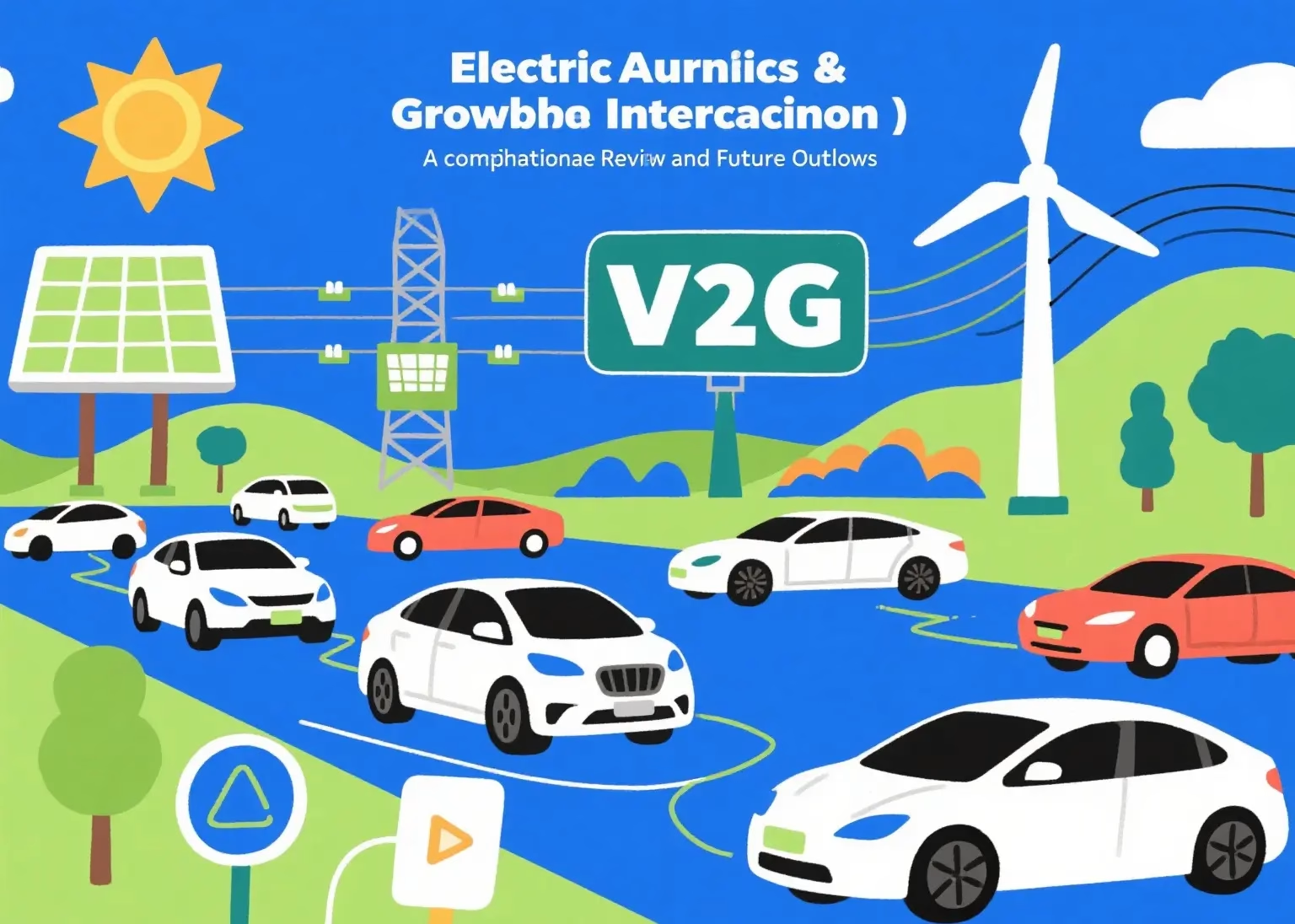
The rapid proliferation of renewable energy generation and electric vehicles (EVs) has brought about significant challenges to the stability and efficiency of power grids worldwide. As the number of EVs on the road continues to surge, the strain on existing power infrastructure becomes increasingly evident, with issues ranging from grid regulation capacity decline to difficulties in accommodating renewable energy sources. Amid these challenges, the concept of Vehicle-to-Grid (V2G) technology has emerged as a promising solution, offering a way to integrate EVs into the power grid as flexible resources that can both consume and supply electricity, thereby addressing multiple issues simultaneously.
A recent comprehensive review published in Automation of Electric Power Systems delves into the current state of V2G research, policy frameworks, infrastructure development, information security concerns, and real-world applications. The study, led by Huang Xueliang from the School of Electrical Engineering at Southeast University, along with collaborators Liu Yongdong from the Standardization Center of China Electricity Council, Shen Fei from Shanghai Nio Inc. Co., Ltd., and other researchers from Southeast University, provides a detailed analysis of the progress made in the field and outlines potential future directions.
The Growing Significance of V2G Technology
The rise of EVs is undeniable. By the end of June 2023, the number of EVs in China alone had reached 12.594 million, accompanied by over 6.6 million charging piles. Projections suggest that by 2030, China’s EV ownership could hit 83 million, with equivalent energy storage capacity reaching 5 TW·h. This massive influx of EVs is set to have a profound impact on power grids, with EV charging demand expected to account for 6% to 7% of total social electricity consumption and peak charging loads making up 11% to 12% of grid loads.
This rapid growth presents a dual challenge: meeting the soaring charging demands while ensuring the stability of the power grid. However, EVs are not just consumers of electricity; they also possess the potential to act as distributed energy storage devices. When properly managed, EVs can provide a range of auxiliary services to the grid, including peak shaving, frequency regulation, voltage control, and the elimination of local congestion. This dual role of EVs as both load and resource underscores the importance of V2G technology, which enables bidirectional energy flow between EVs and the grid, along with the necessary information exchange to manage this interaction effectively.
Technological Foundations of V2G
The review highlights several key technological areas that form the backbone of V2G systems. Understanding the characteristics of EV resources is crucial for optimizing their integration into the grid. EVs can be viewed as flexible loads or distributed storage devices, and their ability to contribute to grid stability depends on various factors, including user behavior, vehicle parameters, and infrastructure capabilities.
User behavior, such as travel patterns and charging preferences, plays a significant role in determining the availability and flexibility of EVs for grid services. For instance, EVs that are parked for extended periods during work hours or overnight represent untapped potential for providing energy storage or load-shifting services. Analyzing these patterns using techniques like origin-destination (OD) analysis and Markov chains helps in modeling EV behavior and predicting their availability for V2G applications.
Charging load characteristics, both in terms of time and space, are another critical aspect. The timing and location of EV charging can significantly impact grid loads, with uncoordinated charging potentially leading to peak demand spikes. To address this, researchers have developed predictive models using both simulation and data-driven approaches. Simulation methods focus on modeling driving and charging patterns to forecast loads, while data-driven approaches leverage historical data to identify trends and make accurate predictions. Combining these methods with considerations of external factors like traffic and geography enhances the precision of load forecasting, enabling more effective grid management.
Control frameworks and management strategies are essential for coordinating the interactions between EVs and the grid. The review identifies three primary control modes: decentralized, centralized, and hierarchical. Decentralized control allows individual EVs to make local decisions, offering simplicity and low cost but lacking global optimization. Centralized control, on the other hand, involves a central authority managing all EVs, ensuring global efficiency but requiring significant communication and computational resources. Hierarchical control strikes a balance by introducing an aggregator layer that coordinates groups of EVs, reducing the burden on central systems while still enabling effective coordination.
Incentive mechanisms and market models are vital for encouraging user participation in V2G programs. Time-of-use pricing and demand response programs are commonly used to influence charging behavior, but more sophisticated approaches involving game theory and multi-stage optimization are being explored. These models aim to balance the interests of users, aggregators, and grid operators, ensuring that all parties benefit from V2G participation. For example, dynamic pricing strategies can encourage users to charge during off-peak hours, reducing grid stress, while also providing financial incentives for users to allow their EVs to discharge back to the grid during peak demand periods.
Policy and Standards: Shaping the V2G Landscape
The development and deployment of V2G technology are heavily influenced by policy frameworks and technical standards. Governments and international organizations worldwide are recognizing the importance of V2G and are implementing measures to support its growth.
In the United States, California has taken a leading role with mandatory policies such as SB-676 and SB-233, which promote V2G integration and require new EVs to have bidirectional charging capabilities by 2030. These policies are complemented by regulatory efforts to adapt the grid to high levels of distributed energy resources, including solar, storage, and EVs.
China has also made significant strides in promoting V2G technology through a series of national and local policies. The New Energy Vehicle Industry Development Plan (2021–2035) emphasizes the integration of EVs with the energy system, while subsequent guidelines encourage smart and orderly charging, and the development of bidirectional interaction between EVs and the grid. Local governments, such as those in Shanghai, Shenzhen, and Jiangsu, have implemented pilot projects and supportive measures to accelerate V2G adoption.
Technical standards are equally important for ensuring interoperability and safety in V2G systems. International organizations like the International Electrotechnical Commission (IEC), International Organization for Standardization (ISO), and Institute of Electrical and Electronics Engineers (IEEE) have developed standards covering charging interfaces, communication protocols, and grid integration. For example, IEC 61851 and IEC 62196 define requirements for charging systems and connectors, while ISO 15118 focuses on communication between EVs and the grid.
In China, efforts to develop a comprehensive V2G standard system have been ongoing since 2017, with a focus on scenarios like residential areas and parking lots, where slow charging is prevalent. The recent approval of the ChaoJi charging technology roadmap marks a significant step forward, providing a foundation for large-scale V2G deployment.
Infrastructure and Platforms: Enabling V2G Integration
The successful implementation of V2G technology relies on robust infrastructure and advanced management platforms. Charging facilities, including AC chargers, DC fast chargers, wireless charging systems, and battery swapping stations, form the physical backbone of V2G. These facilities need to support bidirectional energy flow, requiring specialized components like bidirectional converters.
Wireless charging technology, in particular, shows promise for enhancing V2G integration by simplifying the connection process between EVs and the grid. Static wireless charging systems in parking lots and dynamic systems embedded in roads could enable seamless energy transfer, increasing the frequency and convenience of V2G interactions.
Energy management platforms play a central role in coordinating V2G operations. These platforms, which include grid management systems, charging service providers, and vehicle monitoring systems, need to handle large volumes of data, facilitate communication between various stakeholders, and optimize energy flows. Integrating these platforms with other systems, such as traffic management and weather services, can further improve the efficiency and reliability of V2G operations.
However, current infrastructure and platforms face several challenges. Many existing charging facilities lack bidirectional capabilities, and there is a need for greater interoperability between different systems. Additionally, the sheer volume of data generated by V2G interactions requires advanced data processing and analytics capabilities to ensure real-time decision-making.
Information Security: Protecting V2G Ecosystems
As V2G systems involve extensive data exchange between EVs, charging stations, grid operators, and other parties, information security is a critical concern. The review identifies several key security areas, including network security, interface security, data security, and privacy protection.
Network security ensures that communication between different components of the V2G system is secure from unauthorized access and attacks. This involves implementing robust authentication protocols, encryption techniques, and secure communication channels. Interface security focuses on protecting the physical and logical connections between EVs and charging infrastructure, preventing tampering and ensuring secure data transfer.
Data security involves safeguarding the vast amounts of data generated by V2G operations, including user information, charging patterns, and grid status. Encryption, both symmetric and asymmetric, is used to protect data during transmission and storage. Privacy protection is particularly important, as V2G systems collect sensitive information about users’ driving and charging habits. Techniques like data minimization, anonymization, and privacy-preserving computation are employed to balance data utility with user privacy.
Privacy-preserving computation, such as homomorphic encryption and federated learning, allows for data analysis without exposing raw data, enabling collaborative optimization between different stakeholders while protecting user privacy. These techniques are increasingly being explored for their potential to address the privacy concerns associated with V2G systems.
Demonstration Applications: Real-World V2G Implementations
Around the world, numerous demonstration projects are showcasing the potential of V2G technology. In Europe, projects in the UK, Sweden, and the Netherlands are exploring V2G applications for peak shaving, frequency regulation, and integration with renewable energy sources. For example, Nissan’s V2G trials in the UK use bidirectional charging to provide grid services, while projects in Sweden are testing V2G in university campuses and corporate headquarters.
In North America, initiatives like Peak Power’s Peak Drive project in Canada are demonstrating how EVs can provide backup power during peak demand periods. In the US, collaborations between automakers and utilities, such as Toyota and Oncor, are testing V2G integration in residential and commercial settings.
China has also seen a surge in V2G pilot projects. In Shanghai, EVs are being used to provide demand response services, helping to balance grid loads. In Zhejiang Province, a large-scale demonstration involving over 50,000 charging piles has successfully achieved peak shaving and valley filling. Other projects, such as the “photovoltaic-storage-charging-discharging” integrated systems in Shandong and Jiangsu, are exploring the synergies between renewable energy generation, energy storage, and V2G.
These demonstrations have shown promising results, with significant reductions in peak loads, improved grid stability, and increased integration of renewable energy. However, they also highlight challenges such as the need for better infrastructure, more effective incentive mechanisms, and greater standardization.
Future Directions for V2G Research and Development
The review identifies several key areas for future research and development to advance V2G technology. Enhancing the modeling and prediction of EV behavior, including travel patterns and charging preferences, will improve the accuracy of load forecasting and resource allocation. Developing more sophisticated control strategies, including multi-level optimization and real-time decision-making, will enable more efficient V2G operations.
Policy and standardization efforts need to continue, with a focus on developing comprehensive frameworks that support V2G integration, ensure interoperability, and protect user interests. Expanding infrastructure, including bidirectional charging facilities and advanced management platforms, is essential for scaling up V2G deployment.
Information security will remain a priority, with ongoing research into more robust encryption techniques, privacy-preserving algorithms, and secure authentication methods. Additionally, exploring new business models and market mechanisms will be crucial for incentivizing widespread adoption of V2G technology.
Conclusion
V2G technology holds great promise for addressing the challenges posed by the rapid growth of EVs and renewable energy sources. By enabling bidirectional energy flow between EVs and the grid, V2G can improve grid stability, enhance renewable energy integration, and provide new services and revenue streams for users and utilities.
However, realizing the full potential of V2G requires concerted efforts across technology development, policy formulation, infrastructure deployment, and security enhancement. The comprehensive review by Huang Xueliang and his colleagues provides a valuable roadmap for future research and implementation, highlighting the progress made so far and the challenges that lie ahead.
As V2G technology continues to evolve, it is poised to play a central role in the transition to a more sustainable, flexible, and efficient energy system. With ongoing advancements in technology, supportive policies, and growing real-world applications, V2G is set to become a cornerstone of the smart grid ecosystem.
Author Information:
Huang Xueliang1, Liu Yongdong2, Shen Fei3, Gao Shan1, Gu Yaru1, Yang Zexin1, Wen Xin1
- School of Electrical Engineering, Southeast University, Nanjing 210096, China;
- Standardization Center of China Electricity Council, Beijing 100761, China;
- Shanghai Nio Inc. Co., Ltd., Shanghai 102600, China
Journal: Automation of Electric Power Systems
DOI: 10.7500/AEPS20230727008