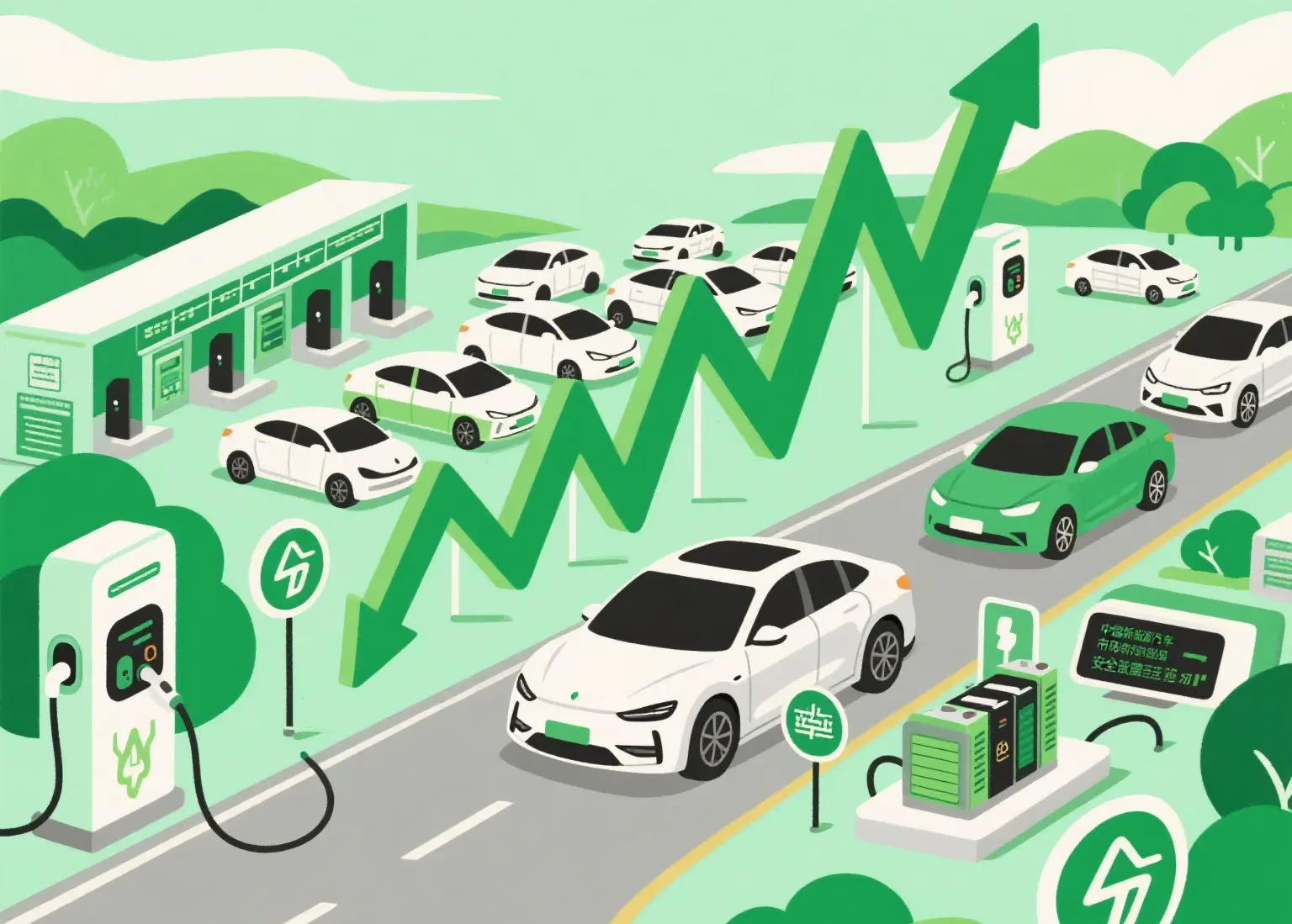
As China’s new energy vehicle (NEV) industry enters a market-oriented expansion phase, the ownership of NEVs continues to grow at a rapid pace. This surge not only reflects the success of the country’s transition to green mobility but also underscores the critical need for enhanced safety measures in charging and swapping infrastructure. Safety, widely regarded as the lifeline of the industry, encompasses multiple dimensions, including the safety of charging facilities themselves, charging interfaces, vehicle and battery systems, and information security.
The foundation of a robust safety framework lies in policy guidance and standardization. As early as 2020, swap stations were included in the scope of new infrastructure construction in the government work report, with further emphasis in 2021. That same year, the national standard GB/T 40032-2021 Safety Requirements for Electric Vehicle Battery Swapping was implemented, marking the first basic and universal national standard in China’s automotive industry for the swapping sector. This standard significantly improved the safety levels of electric vehicles using swapping technology in terms of mechanical strength, electrical safety, and environmental adaptability.
In 2023, the State Council issued the Guiding Opinions on Further Building a High-Quality Charging Infrastructure System, clarifying the main responsibilities and safety management systems for charging safety. Concurrently, the annual compilation of the Electric Vehicle Safety Guide by the China Association of Automobile Manufacturers, China Electric Vehicle Charging Alliance, and Battery Alliance since 2019 has provided valuable references and guidance for NEV developers, practitioners, and service personnel in ensuring safety.
Battery safety, often referred to as the “heart” of NEVs, is paramount to the overall safety performance of vehicles. Recent years have witnessed a series of battery safety incidents, serving as a stark reminder to the industry. Data from the China Automotive Power Battery Industry Innovation Alliance shows that the cumulative installed capacity of domestic power batteries reached 203.3 GWh in the first half of this year, a year-on-year increase of 33.7%. This rapid growth in battery usage heightens the urgency of addressing battery safety challenges.
From a technical perspective, the industry’s basic approach to controlling battery safety involves a four-step strategy: safety boundary control, pre-warning, in-process risk assessment, and post-incident risk control. Experts categorize battery safety issues into three main types: thermal abuse, electrical abuse, and mechanical abuse. Thermal abuse occurs when external high-temperature environments affect the battery, while electrical abuse includes scenarios such as overly fast charging, which can cause lithium dendrites to pierce the separator during energy transfer. Mechanical abuse refers to situations like battery collisions or crushing.These issues can overlap; for example, fast charging may trigger both electrical abuse and thermal abuse, as the increased internal resistance during charging leads to higher heat generation and temperature rise.
The push for faster charging, driven by the need to enhance user convenience and reduce societal operational costs, is an inevitable trend. However, balancing speed with safety is crucial. Industry experts suggest that automakers should first stabilize 3C charging (where batteries can be fully charged in 20 minutes) before implementing 4C charging (15-minute charging), and then proceed steadily toward more efficient charging technologies. This phased approach ensures that safety is not compromised in the pursuit of convenience.
Charging infrastructure has evolved beyond standalone station equipment to become a key component of a broader charging infrastructure network. These facilities act as hubs connecting electric vehicles to advanced power systems, integrating vehicle networks, charging networks, and power grids. Consequently, they demand stricter safety requirements and comprehensive safeguards.
Despite advancements, the industry’s focus on charging infrastructure safety remains insufficient, leading to recurring incidents such as thermal runaway during charging, short circuits and electric leakage in charging piles endangering personal safety, and hacking of charging operation platforms causing service disruptions. To address these, experts propose a multi-faceted approach covering personal safety, vehicle safety, equipment safety, energy storage safety, and data safety.
Critical components like charging guns, being vulnerable parts of charging piles, face high demands due to their characteristics: large current-carrying capacity requiring high safety, frequent plugging and unplugging necessitating durability, and direct user interaction mandating ease of use. These factors collectively require long-term quality stability. Innovations such as AI-driven algorithms to monitor and predict the remaining service life of charging guns enable predictive maintenance, helping operators prevent risks proactively.
While battery swapping offers the advantage of rapid energy replenishment, comparable to refueling in convenience, its safety has become a focal point as swapping facilities are deployed on a larger scale. In the heavy-duty truck sector, for instance, cumulative sales of battery-swapping heavy-duty trucks exceeded 10,000 units in the first half of 2024, an 82% increase from 5,729 units in the same period the previous year. This growth amplifies the importance of swapping safety in ensuring sustainable industry development, legal compliance, brand reputation, technological innovation, data security, and emergency response capabilities.
Safety in battery swapping involves critical considerations in design, site selection, construction, and operation. Operational aspects, in particular, encompass equipment management, operational management, and battery management, with special attention to the safe transportation and storage of batteries. Industry experts summarize the core safety principles as “prevention, early detection, and rapid removal.”
The national standard GB 38031-2020 Safety Requirements for Power Batteries for Electric Vehicles, which prohibits thermal runaway in batteries, serves as a foundational “prevention” measure. Real-time secondary protection measures at swap stations, combined with cloud-based big data analysis of historical battery data, enable “early detection” by monitoring charging status for signs of risk and tracking deterioration trends in battery performance. The “rapid removal” capability, a unique advantage of swap stations, allows batteries to be quickly detached from charging compartments, disconnected from external power sources, and moved to safe areas in case of emergencies.
Routine operational protocols further reinforce safety, including regular training for staff during off-peak hours to familiarize them with emergency procedures, 24-hour on-duty systems, and fire-fighting linkage mechanisms.
Standardization plays a pivotal role in mitigating safety risks during charging and discharging. Given the high-voltage electricity transmission in both processes, risks such as electric shock, component overheating, and functional failures necessitate stringent standards. China’s EV standard system covers four key areas: vehicle safety, battery safety, charging safety, and swapping safety.
Vehicle safety standards, such as GB 18384-2020 Safety Requirements for Electric Vehicles, GB 38032-2020 Safety Requirements for Electric Buses, and GB/T 31498-2021 Safety Requirements for Electric Vehicles After Collision, address functional safety, operational safety, protection against electric shock and fire, and post-collision safeguards. Battery safety is governed by GB 38031-2020 Safety Requirements for Power Batteries for Electric Vehicles, which covers normal use, abuse conditions, environmental adaptability, and thermal diffusion in water immersion.
Charging safety standards include GB/T 43332-2023 Safety Requirements for Conductive Charging and Discharging of Electric Vehicles, which specifies requirements for electric shock protection, overheating protection, functional safety, environmental adaptability, and other aspects across non-charging, charging, and post-charging states. Additionally, GB/T 41578-2022 Technical Requirements and Test Methods for Information Security of Electric Vehicle Charging Systems and GB/T 39752-2021 Safety Requirements and Test Specifications for Electric Vehicle Supply Equipment further refine safety protocols.
The issuance and implementation of GB/T 43332-2023 in November 2023 marked a significant step, providing basic principles for designing conductive charging and discharging functions to prevent potential electric shocks, fires, and other hazards. A major milestone came in July this year with the release of GB 44263-2024 Safety Requirements for Electric Vehicle Conductive Charging Systems, the first mandatory national standard for EV charging systems, set to take effect on August 1, 2025. This standard will further improve China’s charging and swapping safety standard system.
The safety of the charging and swapping industry is a pivotal focus in China’s charging infrastructure development in the coming years and a key foundation for promoting the wider adoption of NEVs. The recent Opinions on Accelerating the Comprehensive Green Transformation of Economic and Social Development issued by the Central Committee of the Communist Party of China and the State Council emphasizes building green transportation infrastructure, improving networks of charging (swapping) stations, hydrogen (alcohol) refueling stations, and shore power facilities, while accelerating the development of urban intelligent transportation management systems.
With sustained efforts from the government, industry stakeholders, and technological innovators, China’s EV charging and swapping safety is poised to enter a new phase of development, driving the high-quality growth of the new energy vehicle industry. This progress will not only protect users and assets but also solidify China’s position as a global leader in green mobility, setting benchmarks for safety and sustainability in the global NEV landscape.
Author: Li Bin
Journal: An Tian Xia (Safety World)