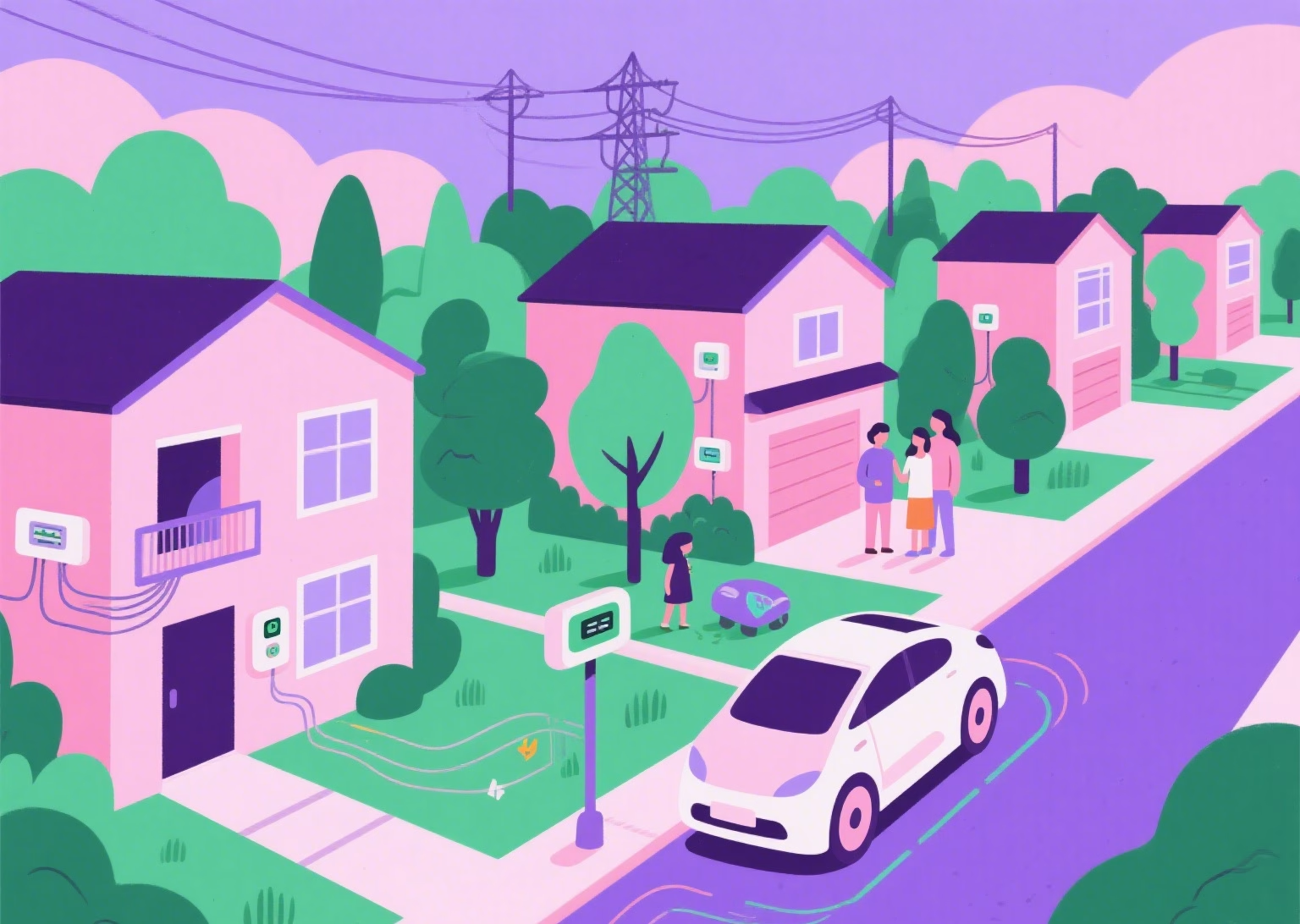
As the construction of new power systems continues to deepen, the electricity sector faces growing challenges with peak-to-valley differences and system volatility. Amid this transition, a groundbreaking approach to load management is emerging—one that leverages the untapped potential of electric vehicles (EVs) and temperature-controlled load clusters to create a more flexible and resilient power infrastructure. This innovative strategy transforms passive consumers into active participants in grid stability, marking a pivotal shift in how modern power systems operate.
The Evolving Power Landscape: Challenges and Opportunities
Global efforts to achieve carbon neutrality have accelerated the restructuring of energy systems worldwide. Traditional fossil fuels are gradually being supplanted by electricity as the primary energy carrier across industries, driving unprecedented growth in power demand. Recent projections indicate increasing strain during peak consumption periods, with supply-demand imbalance becoming a recurring issue during extreme weather seasons.
This paradigm shift presents a unique opportunity: the very loads straining the grid can be transformed into assets. Industrial facilities, commercial buildings, and residential homes collectively harbor massive amounts of adjustable load resources. Effectively harnessing this flexibility to coordinate with renewable energy sources and conventional power plants has become a critical technological pillar for developing sustainable power systems.
“Load control is no longer about simply cutting demand,” explains Dr. Emily Carter, a grid modernization expert. “It’s about intelligent coordination—turning passive consumers into active participants in maintaining grid stability. EVs and temperature-controlled devices represent the largest untapped reservoirs of this flexibility.”
EVs: From Grid Burden to Power Asset
Electric vehicles, once viewed primarily as additional load on the power system, are emerging as dynamic resources capable of providing valuable grid services. Their unique characteristics—predictable usage patterns, storage capacity, and flexible charging schedules—make them ideal candidates for demand response programs.
The typical EV load control response process revolves around understanding each vehicle’s specific constraints and capabilities. By analyzing factors such as departure time, minimum State of Charge (SOC) requirements, and charging power, grid operators can determine the feasible range for load adjustments. This approach ensures that vehicle owners’ mobility needs are met while maximizing the grid benefits of managed charging.
“A single EV might seem insignificant, but when aggregated, thousands of vehicles create a powerful resource,” notes Michael Rodriguez, head of EV integration at a leading utility provider. “Our research shows that properly managed EV fleets can provide both peak shaving and valley filling services, significantly reducing the need for peaking power plants.”
The key to unlocking this potential lies in sophisticated modeling of EV behavior. Researchers have developed detailed algorithms that account for:
- Initial SOC upon connecting to the grid, calculated based on daily driving distance, vehicle efficiency, and battery capacity
- Trip patterns, including start and end times for different vehicle types (private cars, commercial vehicles, etc.)
- Individual user requirements, ensuring that each vehicle meets its owner’s minimum energy needs
By aggregating these individual profiles, grid operators can determine the overall upward and downward adjustment capabilities of EV clusters, creating a flexible resource that can respond to grid conditions in real-time.
Temperature-Controlled Loads: The Hidden Flexibility in Our Homes and Buildings
While EVs offer mobile storage capabilities, stationary temperature-controlled loads—including heat pumps, air conditioners, and refrigeration systems—represent another major source of demand flexibility. These devices benefit from the thermal inertia of buildings and enclosed spaces, allowing for temporary adjustments without compromising comfort.
The dynamic characteristics of temperature-controlled loads create a “controllable region” where power consumption can be adjusted within specific limits. This region is defined by the difference between the current indoor temperature and the user’s comfort range, as well as the rate at which temperature changes when the device is active or inactive.
“Heating and cooling account for a significant portion of peak electricity demand,” says Dr. Sarah Chen, a specialist in building energy systems. “By leveraging the thermal mass of our homes and offices, we can shift energy use away from peak periods without anyone noticing a difference in comfort. It’s a win-win for both grid operators and consumers.”
The control strategy for temperature-controlled loads involves monitoring the indoor temperature relative to predefined comfort boundaries. When temperatures are within the comfortable range but closer to the upper or lower limits, devices can be temporarily turned off or reduced, creating downward adjustment capacity. Conversely, when temperatures are within the comfortable range but further from these limits, devices can be activated to create upward adjustment capacity.
This approach ensures that adjustments remain within user-defined comfort parameters while providing valuable flexibility to the grid. The aggregated effect of thousands of such devices creates a substantial resource that can respond to system needs in real-time.
A New Approach: Optimizing User Combinations for Load Control
Recognizing the complementary strengths of EVs and temperature-controlled loads, researchers have developed an integrated approach to load control that optimizes the combination of these resources. This method categorizes users into two types based on their willingness to participate: peak shifting and peak shedding.
Peak shifting users adjust the timing of their electricity use within a scheduling day without changing their total consumption. For example, an EV owner might delay charging from 7 PM (a peak period) to 1 AM (an off-peak period). This shifts load away from critical times while ensuring the same total energy is used.
Peak shedding users, on the other hand, reduce their overall consumption during peak periods. This might involve temporarily raising the thermostat setting during summer afternoons or delaying non-essential EV charging.
The key innovation in this approach is its comprehensive handling of load rebound—the phenomenon where reduced consumption during controlled periods is followed by increased usage afterward. This rebound can create new peaks that negate the benefits of the initial load control.
To address this, researchers have developed a three-stage rebound load model that predicts post-control consumption spikes based on previous adjustments. This model calculates the rebound amount at time t using a weighted sum of the load adjustments from the previous three periods, with coefficients α, β, and χ representing the relative influence of each prior adjustment. This allows grid operators to anticipate and mitigate potential rebound effects, ensuring that load control measures deliver net benefits to system stability.
Balancing Multiple Objectives: A Multi-Criteria Optimization
The new load control strategy employs a multi-objective optimization framework that balances three critical factors:
- Minimizing the impact on users, ensuring that load adjustments do not significantly disrupt daily activities or comfort
- Reducing financial losses for grid companies resulting from reduced electricity sales during peak periods
- Minimizing load fluctuations to maintain system stability and avoid new peaks
This balanced approach recognizes the complex trade-offs involved in demand response. While reducing peak demand is essential for grid reliability, it must be achieved in a way that is fair to consumers and financially sustainable for utilities.
“Our optimization model treats users as partners, not just resources to be managed,” emphasizes Rodriguez. “By minimizing the impact on individual consumers while achieving system-wide benefits, we can build the trust needed for widespread participation in demand response programs.”
The optimization process also incorporates several key constraints:
- Power balance requirements, ensuring that total adjustments meet the grid’s needs at any given time
- Limits on the number of times each user is called upon to reduce demand, preventing excessive disruption
- Maintenance of safe operating ranges for all devices
- Continuity of energy service, avoiding abrupt changes that could affect equipment or comfort
- Maximum transmission capacity limits to prevent overloads on distribution lines
The model assigns weights (φ₁, φ₂, φ₃) to each objective, allowing grid operators to adjust the optimization based on current priorities—whether minimizing user impact, reducing utility costs, or ensuring system stability.
Real-World Results: Testing the New Approach
To validate the effectiveness of this integrated load control method, researchers conducted a comprehensive case study involving 5 EV clusters and 5 temperature-controlled load clusters, totaling 1,000 users. The results demonstrated significant benefits across multiple dimensions.
During peak periods (19:00 and 20:00), the optimized combination of EV and temperature-controlled load adjustments successfully met the required load reduction targets. The EV clusters were able to provide up to 358 kW (0.358 MW) of reduction at 19:00, while temperature-controlled loads contributed an additional 250 kW (0.250 MW), for a total of 608 kW (0.608 MW)—more than enough to meet the 240 kW (0.240 MW) requirement.
Perhaps most impressively, the approach effectively managed the load rebound phenomenon. By accounting for and mitigating post-control consumption increases, the method reduced the load rebound rate from 76.25% (without rebound management) to just 38.14%. This represents a 50% reduction in the severity of rebound effects, preventing the creation of new peak loads.
“These results are game-changing,” says Carter. “We’ve demonstrated that with the right approach, we can turn two of the biggest challenges in the new power system—EV charging and heating/cooling loads—into part of the solution. It’s a paradigm shift in how we think about grid management.”
The case study also revealed important insights into optimal resource allocation. When both EV and temperature-controlled loads were available, the optimization algorithm consistently prioritized EVs for load adjustments. This decision was based on the higher user comfort impact of adjusting temperature controls compared to delaying EV charging.
“Comfort is subjective but crucial for program acceptance,” explains Chen. “Our algorithm recognizes that a 30-minute delay in EV charging is generally less noticeable than a 2-degree temperature change in someone’s home. This sensitivity to user experience is essential for long-term participation.”
Economic and Environmental Benefits
Beyond the technical achievements, the integrated load control approach delivers substantial economic and environmental benefits. A cost analysis comparing different load control strategies found that combining EV and temperature-controlled load clusters resulted in the lowest total costs, including user inconvenience, utility revenue losses, and load rebound effects.
Compared to using only temperature-controlled loads, the hybrid approach reduced total costs by nearly 43%. Even compared to using only EVs, the combined strategy showed a small but significant cost advantage, primarily due to reduced rebound effects when diverse load resources are coordinated.
“Economics will drive adoption of these new approaches,” notes Rodriguez. “Our analysis shows that smart coordination of different load types isn’t just better for the grid—it’s also more cost-effective. This creates a strong business case for utilities to invest in these demand response capabilities.”
Environmentally, the benefits are equally compelling. By reducing peak demand, the approach minimizes the need for inefficient peaking power plants, which often rely on fossil fuels. The case study estimates that the optimized load control strategy reduced carbon emissions by approximately 15-20% during peak periods compared to conventional grid management.
The Road Ahead: Scaling and Integration
While the results are promising, significant work remains to implement this integrated load control approach on a large scale. Key challenges include:
- Developing user-friendly interfaces that make it easy for consumers to participate while maintaining control over their devices
- Creating appropriate incentive structures to encourage widespread adoption
- Ensuring data privacy and security as more household devices become connected to grid management systems
- Integrating these demand response capabilities with existing grid management systems and market structures
- Adapting the algorithms to different climate zones, housing types, and user demographics
To address these challenges, researchers are working on several fronts. They’re developing more intuitive user portals that provide clear information about when and how devices will be adjusted, along with personalized feedback on energy savings and environmental benefits. They’re also exploring various incentive models, from time-of-use pricing to direct participation rewards.
“User experience will be the make-or-break factor for these technologies,” emphasizes Chen. “We’re focused on creating systems that deliver clear benefits to participants while respecting their preferences and privacy.”
Looking forward, the integration of these demand response capabilities with emerging smart grid technologies holds even greater promise. Artificial intelligence could enable more precise prediction of both supply and demand, allowing for more subtle and effective load adjustments. Blockchain technology might facilitate peer-to-peer energy trading, creating new markets for flexible load resources.
As renewable energy penetration continues to increase, the need for flexible demand will only grow. The ability to dynamically manage EV charging and temperature control systems could prove essential for integrating intermittent wind and solar generation at scale.
“Ultimately, this research points to a future where our homes, cars, and workplaces become active participants in maintaining grid stability,” concludes Carter. “By working with the natural patterns of energy use rather than against them, we can build a more resilient, efficient, and sustainable power system for the 21st century.”
In this future, every EV plugged in at night and every smart thermostat adjusting to changing grid conditions represents a small but vital contribution to a more sustainable energy system. The integrated load control approach described here provides a blueprint for realizing this vision, turning the challenges of the energy transition into opportunities for greater efficiency, reliability, and sustainability.