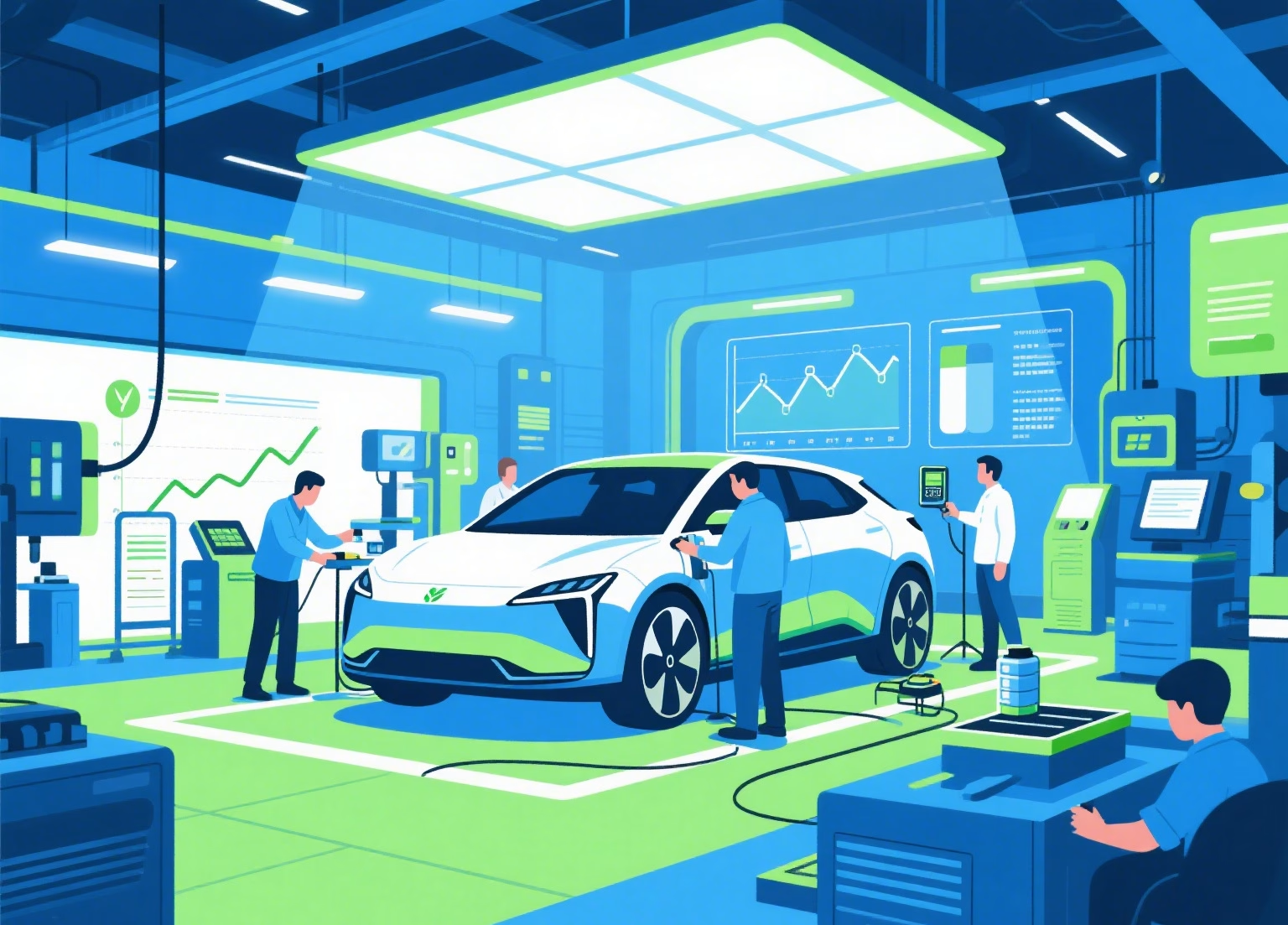
The global surge in new energy vehicle (NEV) adoption has not only transformed transportation but also underscored the critical role of rigorous testing standards and advanced technologies in ensuring safety, performance, and sustainability. As governments push for carbon neutrality and consumers demand more reliable electric and alternative-fuel vehicles, the framework governing NEV testing has evolved into a cornerstone of the industry’s growth. This analysis delves into the current landscape of NEV testing—from existing standards and technologies to emerging trends that will shape the future of mobility.
The Expanding Universe of NEV Testing Standards
The standardization of NEV testing is a multifaceted endeavor, reflecting the complexity of vehicles that rely on batteries, fuel cells, and hybrid systems. A comprehensive review of 52 key standards reveals a structured approach to regulating everything from charging infrastructure to battery safety, with each standard tailored to address specific risks and performance metrics.
These standards are categorized across multiple levels, including national (GB), local (DB), automotive industry (QC), and regional specifications—such as those specific to Shenzhen (SZDB) and professional associations (T/SPSTS). This tiered system ensures that testing criteria are both globally aligned and adaptable to local market needs, balancing uniformity with regional practicality.
A closer look at the distribution of these standards highlights industry priorities. Charging infrastructure, accounting for 17.3% of the total, emerges as a critical focus, reflecting the urgency to build robust, interoperable networks that can support mass NEV adoption. Without standardized charging protocols, disparities in power output, connector design, and safety features could hinder consumer confidence and slow market growth. Similarly, vehicle performance testing, at 15.4%, emphasizes metrics like energy consumption, range, and powertrain efficiency—factors that directly influence consumer purchasing decisions.
Battery and powertrain systems, the heart of any NEV, command 13.5% of standards, underscoring the industry’s commitment to mitigating risks associated with thermal runaway, battery degradation, and electrical failures. Meanwhile, the rising prominence of fuel cell technology is evident in the 11.5% allocation to fuel cell and hydrogen refueling systems, signaling a growing recognition of hydrogen as a viable zero-emission alternative.
Beyond these core areas, standards also cover safety and maintenance (7.7%), natural gas vehicle infrastructure (9.6%), and data collection (1.9%), forming a holistic framework that addresses both vehicle performance and the broader ecosystem in which NEVs operate. This breadth ensures that every stage of an NEV’s lifecycle—from production to operation and maintenance—is subject to rigorous scrutiny.
Cutting-Edge Testing Technologies: Powering Reliability
Behind every standard lies a suite of testing technologies designed to validate compliance and push the boundaries of NEV performance. Today’s testing methodologies are as diverse as the vehicles themselves, encompassing everything from hardware diagnostics to software-driven simulations.
Charging Infrastructure Testing
The backbone of NEV adoption—charging stations—undergoes stringent evaluations to ensure compatibility, safety, and efficiency. Tests focus on power output stability, electrical safety (including protection against short circuits and overvoltage), and the reliability of wireless charging systems. For fast-charging networks, which are critical for long-distance travel, engineers simulate extreme conditions, from high-temperature environments to heavy usage cycles, to guarantee that stations can deliver consistent performance without compromising user safety.
Battery and Powertrain Testing
Batteries are the most expensive and high-risk component of electric vehicles, making their testing paramount. Engineers assess battery cells and packs for capacity retention, thermal management, and durability under repeated charge-discharge cycles. Advanced techniques, such as thermal imaging and pressure testing, identify potential failure points, while software tools model battery behavior over years of use to predict degradation. Similarly, powertrain testing evaluates motor efficiency, torque delivery, and integration with battery systems, ensuring that vehicles deliver the responsiveness and range advertised to consumers.
Fuel Cell and Hydrogen Systems Testing
As fuel cell electric vehicles (FCEVs) gain traction, testing has expanded to cover hydrogen storage, refueling interfaces, and fuel cell stack performance. Hydrogen’s volatility demands rigorous checks on tank integrity, valve reliability, and leak prevention, with specialized equipment measuring pressure retention and material compatibility. Fuel cell stacks, which convert hydrogen into electricity, are tested for power output consistency, cold-start capabilities, and resistance to contaminants—factors that directly impact vehicle range and longevity.
Safety and General Performance Testing
NEVs are subjected to a battery of safety tests, from crash simulations that evaluate structural integrity to electrical system checks that prevent short circuits or fire risks. For hybrid vehicles, which combine internal combustion engines with electric motors, testing focuses on seamless power transition between modes, ensuring reliability under varying loads. Even specialized vehicles, such as commercial trucks and recreational vehicles, undergo tailored assessments—including lateral stability tests for heavy-duty EVs—to ensure they meet the unique demands of their use cases.
The Future of NEV Testing: Smart, Sustainable, and Global
The next generation of NEV testing is poised to be defined by innovation, driven by advances in artificial intelligence, connectivity, and a renewed focus on environmental responsibility. These trends are not just evolutionary; they represent a paradigm shift in how vehicles are validated, monitored, and improved over time.
Intelligence and Automation Take Center Stage
Manual testing, once the industry norm, is giving way to automated systems powered by sensors and AI algorithms. Real-time data analytics allow engineers to monitor vehicle performance across thousands of parameters simultaneously, identifying anomalies that human inspectors might miss. For example, AI-driven battery management systems can predict degradation patterns based on usage data, enabling proactive maintenance and extending battery life. Robotics are also streamlining repetitive tasks, such as endurance testing, reducing human error and accelerating the time it takes to validate new vehicle models.
Holistic, Multi-Dimensional Testing
Future testing will move beyond isolated metrics to evaluate vehicles as integrated systems. This means combining energy efficiency tests with assessments of autonomous driving capabilities, cybersecurity, and user experience. For instance, an electric vehicle’s range will no longer be measured in isolation but will account for how climate control, infotainment, and driver-assist features impact energy consumption. This holistic approach ensures that NEVs meet not just regulatory requirements but also the evolving expectations of tech-savvy consumers.
Eco-Conscious Testing for a Circular Economy
Sustainability is no longer limited to a vehicle’s emissions during use; it now encompasses the entire lifecycle. Tomorrow’s testing protocols will include carbon footprint analyses of manufacturing processes, recyclability assessments of battery materials, and energy efficiency benchmarks for production facilities. This shift aligns with global efforts to reduce industrial waste, pushing automakers to design vehicles that are not just zero-emission on the road but also environmentally responsible from cradle to grave.
Remote Monitoring and Predictive Testing
The rise of 5G and the Internet of Things (IoT) is enabling a revolution in remote testing. Vehicles equipped with IoT sensors can transmit real-time data to cloud-based platforms, allowing engineers to monitor performance in real-world conditions—from busy urban streets to remote rural roads. This capability transforms testing from a one-time certification process into a continuous feedback loop, where potential issues are identified and addressed before they reach consumers. For fleet operators, this means reduced downtime and lower maintenance costs, while manufacturers gain invaluable insights into how their vehicles perform outside controlled laboratory environments.
Global Harmonization of Standards
As NEVs become a global commodity, the need for unified international standards grows increasingly urgent. Divergent testing requirements between regions create barriers to trade, increase costs for manufacturers, and confuse consumers. Efforts to align standards—covering everything from crash safety to charging protocols—are underway, with organizations working to create a common framework that balances rigor with flexibility. A unified global standard would not only streamline innovation but also foster cross-border collaboration, accelerating the development of breakthrough technologies.
Conclusion
The evolution of NEV testing is a testament to the industry’s commitment to safety, innovation, and sustainability. From the intricate web of current standards to the cutting-edge technologies reshaping validation processes, every advancement brings the world closer to a future where electric, fuel cell, and hybrid vehicles are not just alternatives to traditional cars but superior in every way.
As testing becomes smarter, more comprehensive, and globally aligned, it will play a pivotal role in building consumer trust, driving technological progress, and meeting ambitious climate goals. For automakers, embracing these trends is not just a regulatory obligation but a strategic imperative—one that will define their success in a market where excellence is measured in kilometers per kilowatt, seconds to charge, and years of reliable performance.
The road ahead for NEVs is bright, and testing will be the compass guiding the industry toward a cleaner, safer, and more connected world.