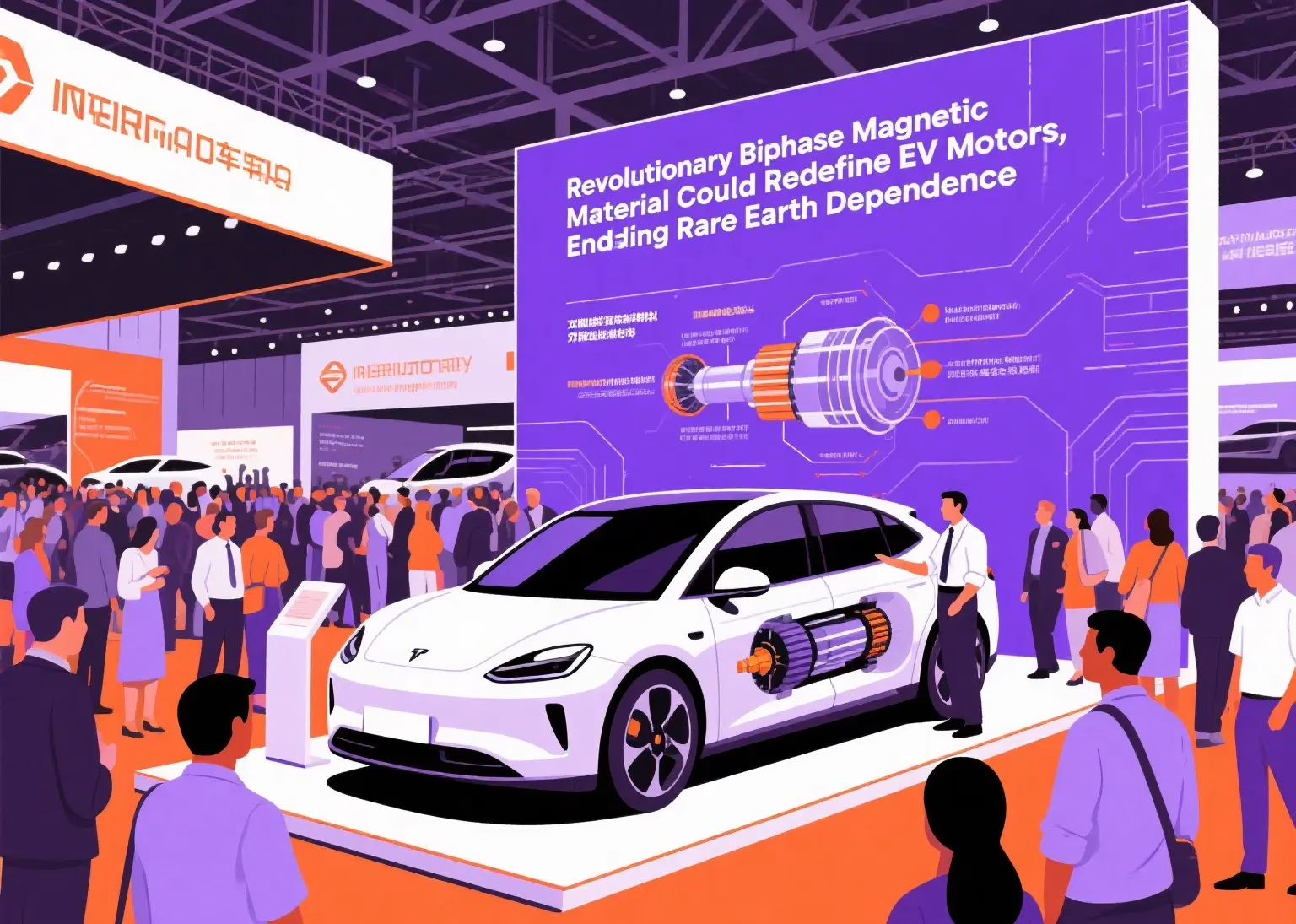
In the race to electrify the global transportation sector, a quiet revolution is brewing in the heart of electric vehicle (EV) technology: a breakthrough in biphase magnetic materials that promises to eliminate the need for rare earth elements in motors while matching or exceeding the performance of today’s best automotive propulsion systems. Developed by researchers at General Electric Aerospace, this innovation could disrupt the status quo of motor design, challenging the decades-long dominance of rare earth-based permanent magnet motors and addressing critical supply chain vulnerabilities that have long plagued the EV industry.
At the core of this advancement lies a reimagining of the synchronous reluctance motor (SynRM), a type of electric motor that, until now, has been overshadowed by permanent magnet motors in high-performance applications like electric vehicles. Unlike permanent magnet motors, which rely on rare earth elements such as neodymium and dysprosium to generate strong magnetic fields, SynRMs operate on the principle of magnetic reluctance—the tendency of ferromagnetic materials to align with magnetic field lines. This fundamental difference eliminates the need for rare earths, but traditional SynRMs have historically struggled with power limitations and mechanical weaknesses that made them impractical for EVs.
The game-changer, according to experts, is the introduction of biphase magnetic materials. These materials exhibit a unique property: when exposed to a strong magnetic field, distinct regions within the material become either highly magnetized or completely non-magnetized. This dual behavior allows engineers to design motor rotors with unprecedented precision, creating structures that optimize both magnetic performance and mechanical strength.
To understand the significance, consider the anatomy of a synchronous reluctance motor. It consists of a stator, which generates a rotating magnetic field, and a rotor, typically made from electrical steel—a ferromagnetic alloy. As the stator’s magnetic field rotates, the rotor aligns with it due to reluctance, producing torque. Critical to this design are the rotor’s “bridges” and “pillars,” structures that connect its magnetic segments. In traditional rotors, these components are made from the same ferromagnetic material as the rest of the rotor, meaning they become magnetized. This magnetization causes magnetic flux lines to interfere with one another, reducing efficiency and limiting power output. To mitigate this, engineers have historically made the bridges and pillars narrow, but this compromises mechanical integrity, restricting rotor speed and, consequently, motor power.
Biphase materials solve this dilemma. By allowing bridges and pillars to remain non-magnetized while being wider and sturdier, they eliminate magnetic interference without sacrificing mechanical strength. General Electric Aerospace’s experimental motor demonstrates the impact: at 14,000 revolutions per minute, it outputs 23 kilowatts, a stark contrast to 3.7 kilowatts from a conventional SynRM rotor under identical conditions. Perhaps more impressively, its peak efficiency reaches 94%, on par with the best motors used in commercial EVs today.
Ayman El-Refaie, an IEEE Fellow and professor of electrical and computer engineering at Marquette University in Milwaukee, Wisconsin, who initiated GE’s biphase material project in 2005, is unequivocal about its potential. “I believe this material will be a game-changer,” he states, highlighting its versatility beyond SynRMs. Research projects at Marquette University, Gyeongsang National University in South Korea, and Ufa State Technical University in Russia have already demonstrated advantages in permanent magnet synchronous motors and generators, suggesting applications far beyond the initial scope of SynRMs.
The implications for the EV industry are profound. Rare earth elements, while essential to current high-performance motors, come with significant drawbacks. They are costly, environmentally damaging to extract and process, and their supply is dominated by China, creating geopolitical and supply chain risks. A shift to rare earth-free motors using biphase materials could alleviate these concerns, reducing production costs, lowering environmental impact, and enhancing supply chain resilience.
Yet, challenges remain. For one, the biphase material’s maximum saturation flux density—1.5 tesla—is lower than the 2-tesla limit of conventional electrical steel. This gap, experts note, could be closed with further development, but technical hurdles may pale in comparison to manufacturing obstacles. Frank Johnson, a senior member of GE’s biphase material research team and now chief technology officer at Niron Magnetics, points out a critical bottleneck: finding steel producers willing and able to manufacture the rolled metal sheets required for biphase rotors. “The alloys we’ve developed have very low cost elements, which creates a paradox,” Johnson explains. “It’s a difficult business case unless there’s very large manufacturing volume and significant investment in equipment.”
Currently, no company offers biphase magnetic materials suitable for high-power machinery. Alongside GE Aerospace, the only other known entity working on such materials is Proterial, formerly Hitachi Metals. GE Aerospace has declined to comment on whether it plans to license or manufacture the material, adding uncertainty to its commercialization timeline.
Despite these challenges, the potential rewards are too great to ignore. If mass-produced, biphase materials could transform not just EVs but a range of electrical machines. “It’s not just internal permanent magnet machines that stand to benefit,” El-Refaie notes. “It has advantages in other types of machines for different reasons.” This includes generators and various motor designs, where their unique magnetic properties could unlock new efficiencies and performance thresholds.
The automotive industry’s shift toward electrification has intensified the search for alternatives to rare earth-dependent technologies. With global EV production soaring, the need for secure, sustainable, and cost-effective motor solutions has never been more urgent. Biphase magnetic materials, though in early stages, represent a promising path forward. They offer a way to break free from rare earth monopolies, reduce environmental costs, and maintain the high performance that consumers and manufacturers demand.
As research continues, the focus will likely shift from lab breakthroughs to scaling production. The collaboration between material scientists, motor engineers, and steel manufacturers will be critical. If these partnerships succeed, the next generation of EVs could be powered by motors that are not only more efficient and powerful but also more resilient and environmentally friendly.
In the end, the true measure of this innovation will be its ability to transition from experimental setups to factory floors. For now, the biphase material developed by GE Aerospace stands as a testament to the power of materials science to reshape industries, offering a glimpse of an electrified future unshackled by the limitations of rare earth elements.
Author: Glenn Zorpette
Affiliation: IEEE Spectrum
DOI: 10.1109/MSPEC.2024.2300123