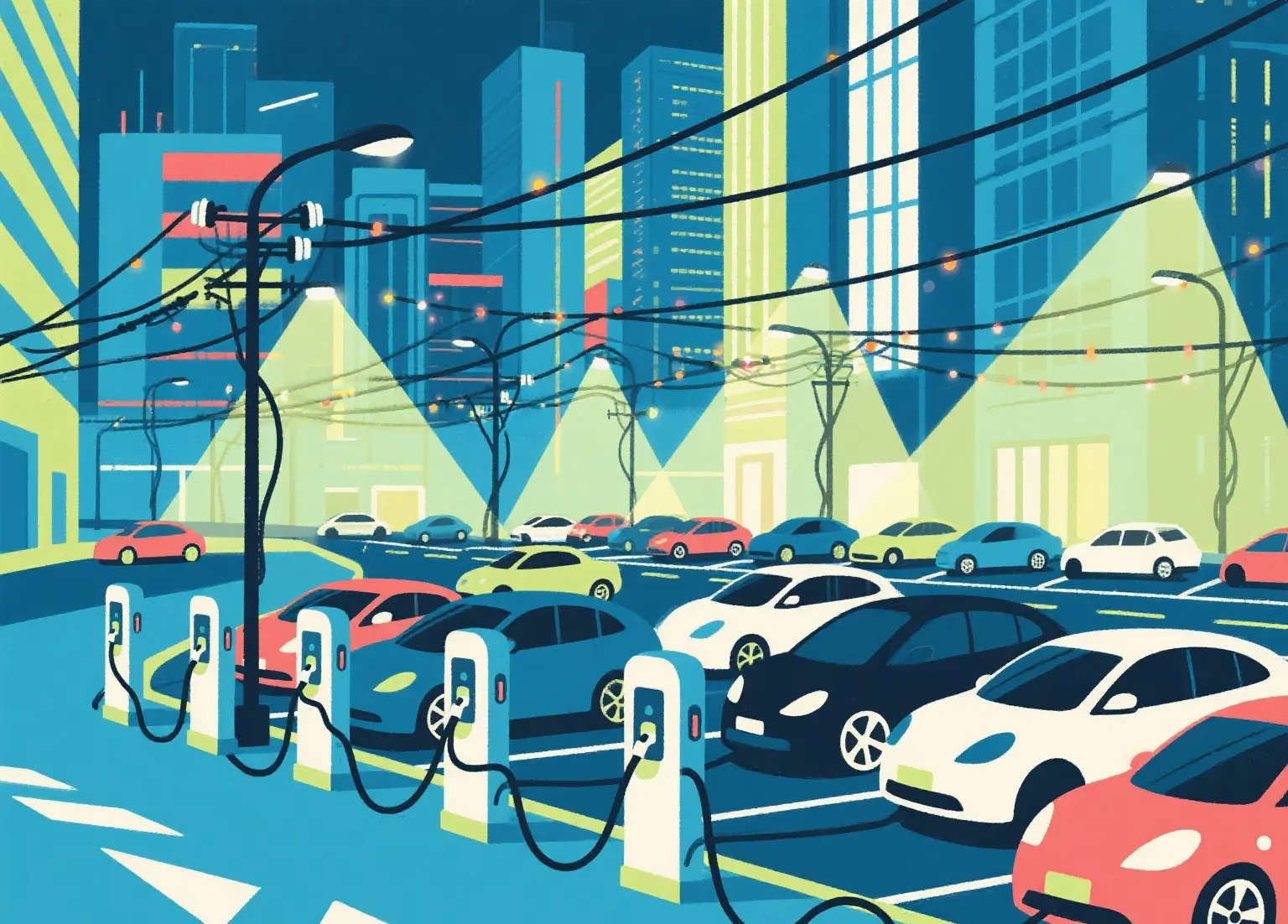
In the fast-evolving landscape of new energy vehicles, the integration of electric vehicles (EVs) into the power grid has become a critical focus. As EV adoption surges, the need for efficient charging management to alleviate grid pressure has never been more pressing. A groundbreaking approach to fleet charging aggregation scheduling, developed by researchers at Tongji University, is set to redefine how EVs interact with the power grid, promising significant benefits for grid stability, cost reduction, and user engagement.
The Growing Need for Smart EV Charging
In recent years, China has been vigorously promoting the development of new energy-related industries. Back in 2020, the General Office of the State Council proposed that new energy vehicles, represented by electric vehicles, should integrate emerging technologies and transform from mere means of transportation into mobile intelligent terminals and energy storage devices. This shift highlights the potential of EVs to play a dual role in transportation and energy systems.
The importance of optimizing EV charging for the safe and stable operation of the power grid cannot be overstated. In 2022, the National Development and Reform Commission and other departments advocated for the promotion of orderly charging to realize the coordinated interaction between electric vehicles and the power grid. This policy direction underscores the urgency of finding effective solutions to manage the increasing number of EVs on the road.
The growth of the EV market has been nothing short of remarkable. In 2022, sales of new energy vehicles reached 6.887 million, with the market penetration rate rising from 2.4% in 2017 to 25% in 2022. However, this rapid increase brings challenges. The large-scale and frequent connection of EVs to the grid has resulted in aggregated loads that burden the grid, while distributed loads cause voltage fluctuations.
Given that EVs possess both energy storage and mobility characteristics, rationally guiding and scheduling their charging and discharging is considered a crucial means to regulate the peak and valley loads of the power grid. Consequently, guiding the aggregated charging of EVs to respond to grid dispatch needs has become a hot research topic.
Existing Challenges in EV Charging Scheduling
EV charging scheduling can be divided into static and dynamic scheduling. Static scheduling addresses the control decisions for charging and discharging when EVs are stationary, optimizing user charging costs, renewable energy utilization, and grid peak-valley differences by adjusting charging and discharging times and power. Dynamic scheduling, on the other hand, handles charging navigation for moving EVs, optimizing charging routes, timing, and locations to reduce costs and time. The former is suitable for private cars and buses, while the latter is more appropriate for commercial EVs.
Dynamic scheduling strategies face several technical hurdles, with the design of incentive schemes to motivate EV response willingness and charging scheduling methods being two key issues. Research has identified factors such as user charging distance, state of charge, and charging costs as major influences on EV users’ willingness to participate in scheduling.
In practice, time-of-use pricing is commonly used to guide EV charging, with various dynamic navigation strategies developed based on this. Building on time-of-use pricing, further reductions in charging waiting times, costs, and total travel time can be achieved by considering queue rates and dynamic time-of-use pricing. Additionally, combining charging station models with battery-constrained scheduling models while accounting for time-of-use pricing can fully utilize charging resources.
Dynamic pricing offers more flexibility than time-of-use pricing but can confuse users due to its spatiotemporal variability. To avoid complex and changing charging price information while still incentivizing and guiding users spatially and temporally, hybrid incentive methods have emerged.
In terms of dynamic charging scheduling method design, model-based real-time scheduling and reinforcement learning-based methods are commonly used. The former employs mathematical programming and heuristic algorithms, offering strong model interpretability but struggling to find optimal solutions quickly. The latter, including deep reinforcement learning and graph reinforcement learning, adapts well to uncertain environments but requires large amounts of input data and incurs high training costs.
Overall, existing scheduling methods often overlook users’ actual willingness to respond to scheduling, their price preferences, and issues of fulfillment credibility in multiple scheduling rounds. Moreover, the mathematical models established for charging scheduling are complex and time-consuming to solve, making them difficult to meet real-time scheduling requirements in practical applications.
A Novel Approach: Hybrid Price-Point Incentive-Based Scheduling
To address these challenges, researchers have developed a multi-objective optimization method suitable for large-scale EV aggregation in grid dispatch, based on a price-point hybrid incentive approach. This innovative method involves several key components working together to create an efficient and user-friendly scheduling system.
Fleet Charging Aggregation Scheduling Framework
The framework establishes a collaborative interaction among the power grid, charging aggregators, and EV users. The main participants in the scheduling process are the power grid, charging aggregators, charging stations/piles, and EVs.
First, the grid, EVs, and charging stations/piles respectively provide information on peak-shaving and valley-filling dispatch needs, charging demands, and station/pile status to the charging aggregator. The aggregator then uses this multi-source information to issue aggregated scheduling guidance to the EV group. Finally, EVs are directed to appropriate times and locations for charging at suitable power levels.
This scheduling approach benefits all parties involved. For the grid, it helps balance peak and valley loads, reduces generator set investments, and stabilizes grid operation. Users gain economic compensation in exchange for some flexibility in charging time and location. Charging aggregators receive rewards from the grid for aggregated charging loads and collect charging service fees from users.
Hybrid Incentive Calculation Model
Building on time-of-use pricing, the hybrid incentive model incorporates an incentive point system where points can be used to offset charging costs. Three point adjustment coefficients are established based on grid load regulation needs, charging station idle status, and user fulfillment integrity to motivate user participation.
The real-time incentive points for each vehicle are calculated considering the amount of charge, charging price, and the three adjustment coefficients. The first coefficient (φ₁) adjusts based on grid load, offering higher incentives when grid load is low and lower incentives during peak load periods. The second coefficient (φ₂) reflects charging station/pile utilization, providing higher incentives when more charging piles are idle. The third coefficient (φ₃) rewards user fulfillment integrity, with higher points for users with better fulfillment records.
User Response Willingness Assessment
Using fuzzy reasoning, the model real-time evaluates EV users’ willingness to participate in grid scheduling based on key influencing factors. The assessment considers the necessity (whether the remaining battery power is sufficient), the attractiveness (whether the incentives are adequate), and the convenience (whether the travel distance is reasonable).
Fuzzy rules, including membership functions and fuzzy control rules, are established based on user surveys and expert knowledge. These rules map combinations of battery state of charge and incentive-to-cost ratios to user willingness probabilities, allowing for a nuanced evaluation of each user’s likelihood to participate.
Vehicle-Station Matching Scheduling Model
The model incorporates several assumptions to simplify the problem while maintaining practical relevance: it does not consider EV discharge after grid connection, assumes constant power charging at stations, and neglects time delays in signal transmission and user feedback.
The decision variable is a binary indicator of whether an EV is assigned to a specific charging station. The objective functions aim to minimize total fleet travel distance, maximize total incentive points, and maximize total charging amount within a specified period.
Several constraints ensure the feasibility of the scheduling: each EV can only choose one charging station; the number of vehicles at a station cannot exceed the number of available charging piles; the distance to the chosen station must be within the range allowed by the EV’s remaining power; the time cost of reaching the station must be balanced by the incentive points gained; the incentive points per unit charge should not exceed a certain proportion of the charging service price; and charging power must not exceed the maximum output of the station’s piles.
Scheduling Strategy and Implementation
The multi-objective linear integer programming model is solved using the Non-dominated Sorting Genetic Algorithm-II (NSGA-II) to ensure efficient and convenient solution finding. The scheduling process involves several steps:
- Reading various types of information, including grid, vehicle, and station data, and initializing calculation parameters.
- Establishing matrices for vehicle-station distances, points, and charging amounts, and calculating hybrid incentives.
- Assessing user willingness by inputting state of charge and incentive-to-cost ratios. If the highest willingness does not meet a set threshold, the vehicle does not participate in scheduling; otherwise, remaining vehicle-station matches are considered feasible solutions.
- Updating the vehicle-station information matrix, invoking the solution algorithm to determine matches, recording user fulfillment integrity during execution, and updating vehicle-station status after execution.
Validation Through Case Studies
To verify the effectiveness of the theoretical model, operational data from 1,000 commercial EVs, 100 charging stations in Hangzhou, and Hangzhou’s electricity load data (provided by State Grid Zhejiang Electric Vehicle Service Co., Ltd., January 2022 data) were used.
EV data included vehicle location, state of charge, nominal battery capacity, and maximum charging power. Charging station data covered the number of piles and maximum charging power. The EVs had a nominal battery capacity of 40 kWh and maximum charging power ranging from 20 to 60 kW. All charging piles in the stations had a maximum power limit of 120 kW, with 6 to 24 piles per station.
EV energy consumption was simulated based on empirical data, averaging approximately 15 kWh per 100 km, with slight variations based on vehicle location and temperature. Baidu Maps’ route planning and real-time traffic interfaces provided vehicle-station distances and real-time road speeds.
The daily electricity load in Hangzhou showed significant troughs between 2:00-8:00 and 14:00-16:00, with peaks around 10:00 and 20:00. The 24-hour time-of-use charging prices for EVs in Hangzhou were divided into six periods, ranging from 0.6 to 1.6 yuan per kWh.
To fully consider user willingness, a willingness threshold was set based on user surveys. Vehicles with a participation probability below 0.5 did not participate. In this case, 883 out of 1,000 vehicles exceeded the threshold. By adjusting incentive point coefficients, participation remained at 80% or higher across multiple scheduling rounds.
The optimal vehicle scheduling solution’s objectives included shortest travel distance, maximum charging amount, and maximum charging points. On average, the 883 vehicles traveled 25.52 km each, with a total response charging amount of 31,957.80 kWh (36.19 kWh per vehicle) and total incentive points worth 23,365.77 yuan (26.46 yuan per vehicle).
Comparative Analysis: Hybrid Incentives vs. Time-of-Use Pricing
A comparison between the hybrid incentive-based aggregation scheduling method and the time-of-use pricing-based method revealed significant advantages for the new approach. Both methods used fuzzy reasoning to determine user response willingness, with the same threshold of 0.5. However, the hybrid incentive method resulted in 883 vehicles willing to participate, compared to 650 with time-of-use pricing.
While the hybrid method increased the average travel distance by 63.4%, it also increased the responsive grid charging amount by 43.6% and reduced the unit electricity cost by 45.7%. These results demonstrate that the hybrid incentive-based charging aggregation scheduling method is more suitable for responding to grid dispatch needs than time-of-use pricing.
Scalability and Generalization
To explore the method’s adaptability to large-scale fleets and charging stations, various vehicle-station size combinations were analyzed, ranging from 1,000 vehicles with 100 stations to 5,000 vehicles with 500 stations. The analysis examined algorithm solution time, travel distance, charging amount, unit electricity cost, and user participation rate.
As the scale increased from 1,000 vehicles/100 stations to 5,000 vehicles/500 stations, the solution time increased approximately linearly, while other indicators remained relatively stable. The average user participation rate stayed above 85%, and the unit electricity cost remained around 0.86-0.87 yuan. In the largest scale case, the method filled 1.25% of the grid load trough, demonstrating its effectiveness in grid valley filling.
These results indicate that the method maintains stable performance across various scales, with only solution time increasing proportionally, making it suitable for large-scale applications.
Conclusion and Future Outlook
In the context of carbon peak and carbon neutrality goals, EVs are being widely promoted, and issues related to charging are gaining increasing attention. The proposed dynamic point-price hybrid incentive-based aggregation scheduling method addresses the problem of commercial EV charging aggregation participating in grid peak-shaving and valley-filling dispatch.
By building on time-of-use pricing and considering grid load, charging station idle status, and user fulfillment integrity, this method effectively motivates EV users to participate in grid scheduling. The inclusion of a fuzzy reasoning model to account for user willingness, combined with NSGA-II algorithm for solving the multi-objective optimization model, has proven successful in practical vehicle-station operation data validation.
The method not only increases fleet aggregation scheduling charging amounts but also significantly reduces EV users’ charging costs. Its effectiveness across various vehicle-station size combinations demonstrates strong generalization performance. With average user participation rates consistently above 85% and successful grid valley filling in large-scale cases, the method shows great promise for widespread application.
This innovative approach provides a new perspective for distribution network dispatch with large-scale EV integration and can be further applied to other research areas such as vehicle-grid interaction and charging station site selection. Future work will incorporate vehicle-to-grid (V2G) scenarios to achieve more efficient grid peak-shaving and valley-filling dispatch.
As the EV market continues to expand, solutions like this will play a crucial role in ensuring grid stability, reducing costs for users, and promoting the sustainable development of new energy transportation. The hybrid price-point incentive-based fleet charging aggregation scheduling method represents a significant step forward in creating a harmonious and efficient relationship between electric vehicles and the power grid.