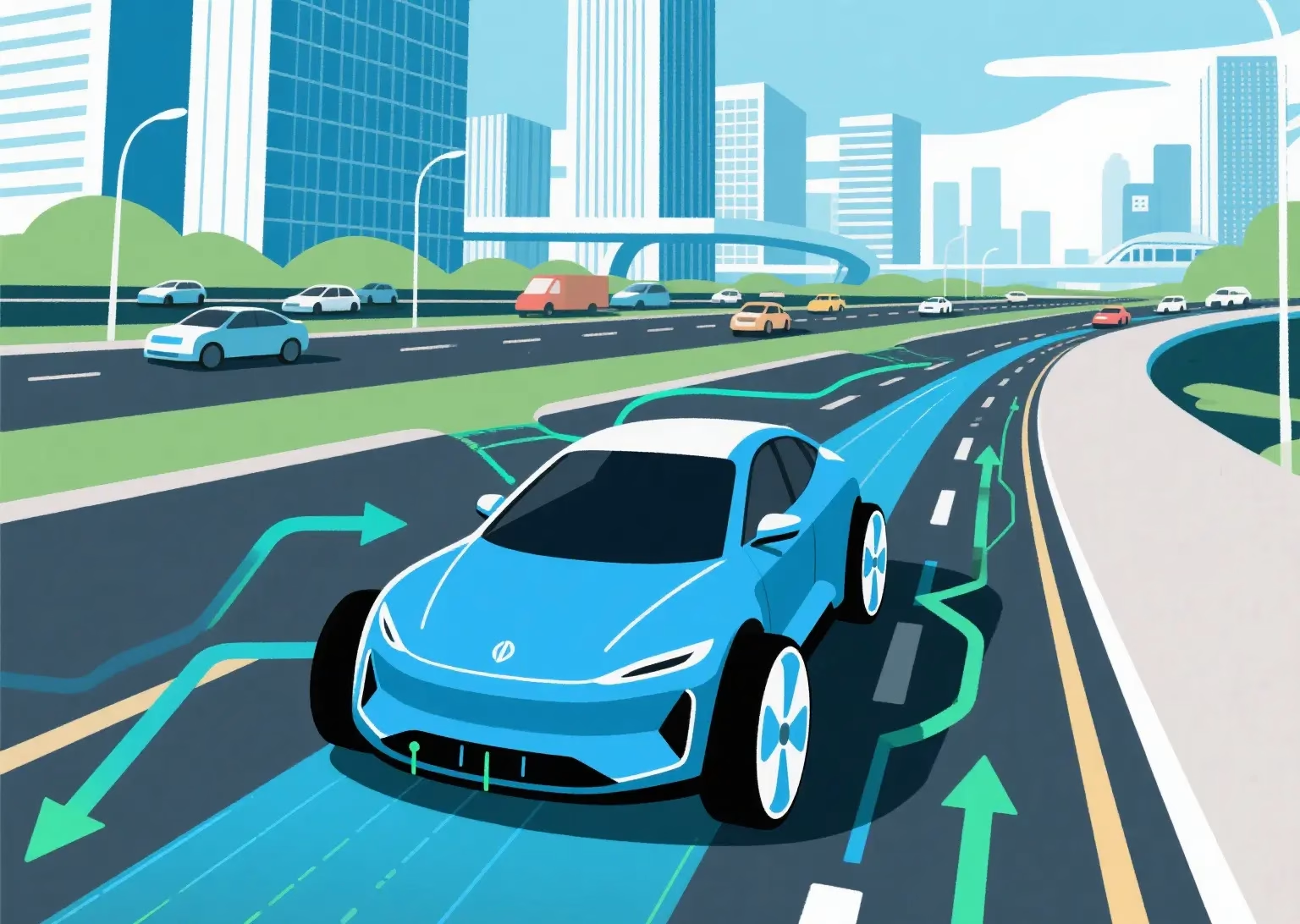
In the fast-evolving landscape of autonomous transportation, a groundbreaking development has emerged from the labs of Dalian Nationalities University, promising to transform the way distributed-drive electric vehicles navigate complex roads. A team of researchers led by Professor Zhang Tao has unveiled a cutting-edge path tracking control strategy that integrates real-time speed optimization with differential steering, marking a significant leap forward in enhancing both precision and safety for driverless cars. This innovation, which addresses longstanding challenges in maintaining stability during high-curvature maneuvers and varying road conditions, could soon become a cornerstone of next-generation electric vehicle (EV) technology.
The Rise of Differential Steering: A Game-Changer for EVs
Distributed-drive electric vehicles, equipped with independent in-wheel motors, have long been hailed for their versatility and efficiency. Unlike traditional vehicles reliant on a single powertrain, these advanced machines can control torque at each wheel individually, enabling functions such as traction control, direct yaw moment adjustment, and even differential steering. Differential steering, a mechanism that induces turns by creating a torque imbalance between the left and right wheels, has gained traction as a viable alternative to conventional steering systems. By varying the driving force between opposite sides, the vehicle naturally leans toward the side with lower torque, eliminating the need for complex mechanical steering linkages.
This approach offers two critical advantages: first, it serves as a fail-safe when electronic steering systems malfunction, preventing catastrophic loss of control—a persistent concern in autonomous vehicle safety. Second, as a primary steering method, it simplifies vehicle design, reduces weight, and extends battery life, all while enhancing maneuverability. “Differential steering isn’t just a backup; it’s a pathway to more agile, energy-efficient EVs,” explains an industry expert. “Imagine a car that can execute a 360-degree turn in place or navigate tight urban alleys with minimal effort—this is the future we’re moving toward.”
Yet, despite its promise, differential steering has faced hurdles in real-world application. Earlier systems often operated under the assumption of constant speed, failing to account for dynamic road conditions such as sharp curves, slippery surfaces, or sudden obstacles. This rigidity led to compromises in either tracking accuracy or stability, limiting the technology’s commercial viability. The new research directly confronts this limitation by embedding speed optimization into the core of the control strategy.
Breaking the Mold: Speed Optimization as a Core Function
Traditional path tracking systems for autonomous vehicles typically rely on fixed-speed models, assuming that the vehicle maintains a steady velocity regardless of terrain. While simpler to implement, this approach overlooks a fundamental truth of driving: speed and trajectory are inherently linked. A car navigating a hairpin turn, for example, requires a significantly lower speed than one cruising down a straight highway to avoid skidding or rollover. Human drivers intuitively adjust their speed based on road curvature, surface traction, and visibility—an instinct that autonomous systems have struggled to replicate.
The Dalian team’s breakthrough lies in its ability to mirror this human-like adaptability. Their algorithm dynamically calculates the maximum safe speed for each segment of the journey, considering factors such as road curvature, friction coefficients, and vehicle dynamics. “We’re not just programming the car to follow a path; we’re teaching it to ‘read’ the road and respond accordingly,” notes Professor Zhang. “This isn’t just about staying on track—it’s about doing so in the most efficient, safe manner possible.”
At the heart of the system is a dual-layered control architecture. The longitudinal control module handles speed adjustment, using a model predictive control (MPC) framework to balance acceleration, deceleration, and energy efficiency. By continuously evaluating road conditions, it ensures the vehicle never exceeds limits that could compromise stability, such as the critical thresholds for skidding or rollover. Simultaneously, the lateral control module manages steering via differential torque, employing a sliding mode control strategy to minimize tracking errors and maintain responsiveness.
How It Works: The Science Behind the Innovation
The technology’s efficacy stems from its sophisticated integration of vehicle dynamics and real-time data processing. The researchers first developed a comprehensive three-degree-of-freedom dynamic model that captures the vehicle’s longitudinal, lateral, and yaw motions. This model serves as the foundation for predicting how the car will respond to changes in torque and speed, allowing the system to anticipate and correct deviations before they occur.
For speed optimization, the algorithm calculates two critical thresholds: the maximum speed to avoid rollover and the maximum speed to prevent skidding. The rollover threshold is determined by factors like vehicle weight distribution, center of gravity height, and wheelbase, ensuring the car remains stable even during sharp turns. The skid threshold, meanwhile, relies on tire-road friction, adjusting for wet, icy, or dry conditions. The system then selects the lower of these two values as the safe speed limit, with a dynamic adjustment factor that accounts for driving style—balancing aggressiveness and caution based on contextual needs.
Once the optimal speed is set, the MPC-based longitudinal controller computes the necessary acceleration or deceleration to reach and maintain that speed. This involves solving a complex optimization problem that minimizes tracking errors while respecting constraints such as maximum torque output and passenger comfort. The result is a smooth, human-like acceleration profile that avoids sudden jolts or delays.
On the lateral control side, the system uses linear time-varying MPC to determine the ideal front wheel angle for following the desired path. This angle is then translated into a torque difference between the left and right wheels via a sliding mode controller, which ensures rapid, precise response even in the face of nonlinear tire behavior and external disturbances. The sliding mode control effectively eliminates “chattering”—a common issue in torque-based systems—by using a saturation function instead of abrupt switching, resulting in smoother, more reliable turns.
Real-World Validation: Testing the Technology
To validate their approach, the researchers subjected the system to rigorous simulation tests using a double-lane change scenario—a standard benchmark for evaluating vehicle stability and maneuverability. The test, conducted using a combination of Carsim and Matlab/Simulink software, pitted the speed-optimized strategy against a conventional fixed-speed control system, with striking results.
In the fixed-speed setup, the vehicle struggled to maintain its path during sharp turns, with lateral errors reaching up to 0.26 meters. The front wheel angle oscillated widely, peaking at 4.83 degrees, while the vehicle’s yaw rate and sideslip angle—key indicators of stability—spiked to 27.1 degrees per second and 1.66 degrees, respectively. These values, while within safe limits, highlighted the system’s vulnerability to loss of control in more extreme conditions.
The speed-optimized system, by contrast, adjusted its velocity dynamically, slowing down during curves and accelerating on straightaways. This adaptability reduced the maximum lateral error to a mere 0.042 meters—a 81% improvement. Front wheel angle fluctuations were cut by 31%, yaw rate by 18%, and sideslip angle by 28%. Perhaps most impressively, the vehicle maintained these improvements while adhering to realistic driving constraints, such as maximum acceleration and torque limits.
“These results aren’t just numbers—they represent a paradigm shift,” says an automotive engineering consultant. “By linking speed and steering, the system achieves what humans do naturally: it balances caution and progress. For autonomous vehicles to gain widespread acceptance, they must not only be safe but also feel intuitive to passengers. This technology brings us closer to that goal.”
Implications for the Future of Autonomous Driving
The implications of this research extend far beyond laboratory simulations. For automakers, the integration of speed-optimized differential steering could streamline EV design, reducing reliance on complex steering hardware and lowering production costs. The simplified architecture also translates to lighter vehicles, extending battery range—a critical selling point in the competitive EV market.
For urban mobility, the technology promises to enhance the maneuverability of autonomous shuttles and delivery vehicles, enabling them to navigate crowded streets, narrow alleys, and parking lots with unprecedented precision. Imagine a delivery robot that can pivot in place to squeeze into a tight loading zone or a public transit shuttle that glides through a construction zone with millimeter-perfect accuracy—these scenarios are now within reach.
Safety, too, stands to benefit. By dynamically adjusting speed to road conditions, the system minimizes the risk of skidding or rollover, particularly in adverse weather. The fail-safe nature of differential steering, which provides redundancy for traditional steering systems, adds another layer of protection against mechanical or electronic failures.
Looking ahead, the research team plans to refine the technology through real-world testing, focusing on extreme conditions such as icy roads, uneven terrain, and high-speed highway maneuvers. They also aim to integrate machine learning algorithms that adapt to individual driving styles, further bridging the gap between autonomous and human-driven vehicles.
Industry Reactions and Adoption Prospects
Automotive industry leaders have taken notice of the breakthrough. Executives at major EV manufacturers have praised the research for its practicality, noting that the speed optimization framework can be integrated into existing autonomous driving stacks with minimal modification. “This isn’t a pie-in-the-sky concept—it’s a deployable technology,” says a senior engineer at a leading EV company. “We’re already exploring partnerships to test it in our next-generation prototypes.”
Regulators, too, see value in the approach. The dynamic speed adjustment aligns with emerging safety standards that emphasize context-aware decision-making in autonomous systems. By demonstrating reduced error margins and enhanced stability, the technology could accelerate the approval process for autonomous vehicles in markets worldwide.
Consumer acceptance remains a wildcard, but early indicators are positive. Focus groups have reacted favorably to the idea of autonomous vehicles that “drive like humans,” with speed adjustments that feel natural rather than abrupt. “Trust is built on familiarity,” explains a market research analyst. “If an autonomous car behaves like a skilled human driver—slowing down for curves, speeding up on straights—people are more likely to embrace it.”
Conclusion: A Step Toward Smarter, Safer Roads
As autonomous driving technology continues to mature, innovations like the speed-optimized differential steering system are paving the way for a future where driverless vehicles are not just a novelty but a reliable, integral part of daily life. By combining precision engineering with a deep understanding of human driving intuition, the researchers at Dalian Nationalities University have created more than a control algorithm—they’ve crafted a blueprint for the next generation of transportation.
In a world where urban congestion, climate change, and safety concerns drive the demand for smarter mobility solutions, this breakthrough couldn’t come at a better time. It’s a reminder that the most impactful technologies are those that don’t just replace human capabilities but enhance them—turning the complexities of the road into a symphony of speed, precision, and safety.
The road to fully autonomous transportation is long, but with innovations like this, we’re one significant step closer to reaching the destination.