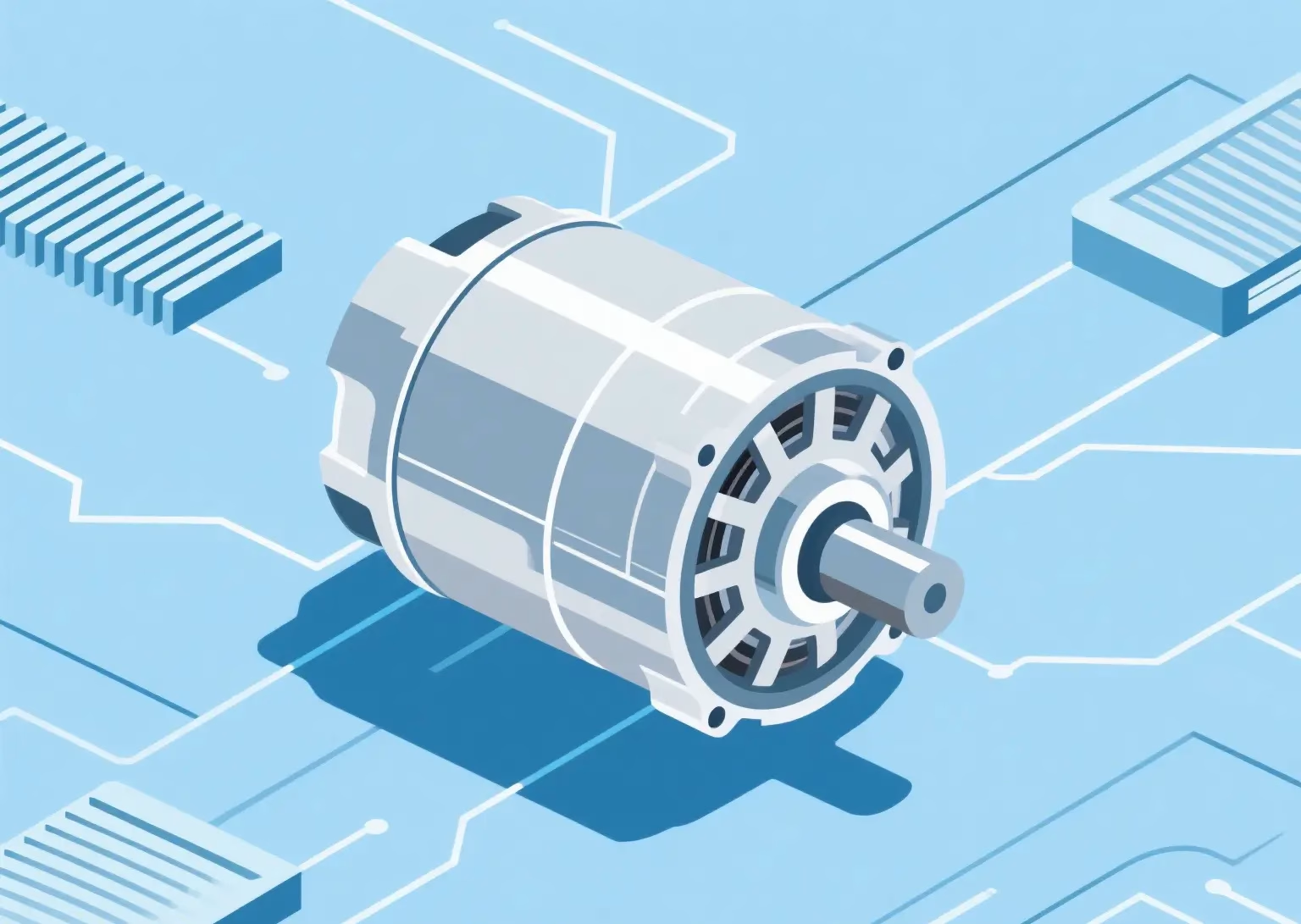
The global shift toward sustainable transportation has propelled the electric vehicle (EV) industry into a period of unprecedented growth, with driving motors emerging as a critical focal point for innovation. As environmental concerns, energy security issues, and the pressing need to mitigate the greenhouse effect continue to gain traction worldwide, the performance of EVs—largely dictated by their driving motors—has become a key determinant of market success. This detailed analysis explores the current state of centralized driving motor technology, examining the latest developments in motor types, topological structures, thermal management systems, and future trends that are shaping the next generation of electric vehicles.
Centralized driving systems, which replace traditional internal combustion engines with a single main drive motor, remain the dominant configuration in today’s EV market. This approach, which transmits power to the wheels through established mechanical components like drive shafts and differentials, offers proven reliability and mature manufacturing processes. While distributed driving systems—including wheel-side and in-wheel motor configurations—show promise for future applications by eliminating mechanical differentials and improving control precision, they still face significant hurdles such as excessive unsprung mass, sealing challenges, and complex thermal management requirements. For now, centralized driving remains the backbone of the electric vehicle industry, with continuous refinements driving performance improvements across the board.
The significance of driving motor technology is underscored by the rapid expansion of the EV market. Recent figures show that new energy passenger vehicle sales reached 7.2495 million units in 2023, representing a 38.5% year-on-year increase, with driving motor installations totaling 8.33 million units—a 44% jump from the previous year. This growth trajectory reflects not only consumer demand but also the industry’s response to regulatory pressures, including China’s “Dual Carbon” goals and the U.S. Department of Energy’s target of achieving 5.7 kW/kg power density for driving motors by 2025. Major automakers and suppliers, from Tesla and Volkswagen to BYD and NIO Drive Technology, are investing heavily in motor technology to gain competitive advantages in this burgeoning market.
Motor Types and Their Applications in Modern EVs
The current landscape of EV driving motors encompasses several distinct technologies, each with unique characteristics that influence their adoption by manufacturers. Permanent magnet synchronous motors (PMSMs) have emerged as the industry leader, thanks to their exceptional efficiency and high-speed capabilities. These motors are categorized by their rotor structures—surface-mounted and interior types—with the latter gaining widespread use due to its ability to utilize reluctance torque, reducing permanent magnet usage and overall costs. This design has been adopted by major global brands including Toyota, Honda, Volkswagen, and BMW, solidifying PMSMs’ position as the dominant technology in the sector.
Induction motors, while less efficient in certain operating ranges, maintain a significant presence in markets like the United States and parts of Europe, employed by manufacturers such as Tesla, Ford, and Chevrolet. Their continued use stems from multiple factors: avoidance of rare earth materials—strategic resources with volatile pricing—elimination of demagnetization risks, and superior efficiency in high-speed highway conditions, which aligns with the well-developed infrastructure in these regions. This technology choice reflects both strategic material sourcing considerations and adaptation to specific market requirements.
Switched reluctance motors offer unique advantages including simple construction and high reliability, as their rotors contain no coils or permanent magnets. Their speed-torque characteristics align well with EV operating demands, yet their application remains limited due to significant torque ripple and noise issues that compromise driving comfort. Despite these challenges, they find niche applications in certain hybrid vehicles and commercial applications where their robustness is prioritized.
Electrically excited synchronous motors represent another area of active development, attracting attention for their adjustable excitation and high efficiency. BMW’s iX3 exemplifies this technology, utilizing a brush module to supply power to rotor windings, while companies like ZF have developed induction-excited synchronous motors that transmit magnetic field energy through an internal induction exciter, eliminating the need for brushes and improving reliability. While these motors address some limitations of permanent magnet designs, they introduce complexities such as rotor winding power supply requirements and excitation losses that must be managed.
A notable trend in motor development is the push toward reduced rare earth material usage, driven by supply chain concerns and cost considerations. Three primary strategies have emerged: enhancing reluctance torque through multi-layer rotor flux barrier designs, reducing heavy rare earth content while increasing lighter alternatives, and substituting neodymium-iron-boron magnets with ferrite materials. While these approaches show promise, current implementations still lag behind traditional PMSMs in efficiency and torque density, indicating that further research breakthroughs are necessary to fully realize their potential.
To optimize vehicle performance across diverse operating conditions, some manufacturers have adopted dual-motor configurations that combine different motor types, leveraging the strengths of each to expand the high-efficiency operating range and improve overall vehicle range. This hybrid approach represents a strategic response to the complex performance requirements of modern EVs, balancing efficiency, power, and cost considerations.
Innovations in Motor Topological Structures
Advancements in motor design have focused heavily on topological innovations aimed at improving efficiency, power density, and thermal performance. Rotor design evolution has been particularly noteworthy, with interior permanent magnet synchronous motors adopting various configurations including in-line, V-type, double V-type, and -type structures. Toyota’s Prius series provides a compelling case study in this evolution, with each generation demonstrating significant improvements: from the first generation’s 6000 r/min in-line rotor to the fourth generation’s 17000 r/min V-type magnetic pole structure. These advancements reflect a deliberate focus on reducing permanent magnet usage, enhancing reluctance torque, and increasing power density through high-speed operation, with each redesign addressing specific performance limitations of its predecessor.
High-speed operation has emerged as a key performance metric, with several manufacturers pushing rotor speeds beyond 20000 r/min. This trend presents significant engineering challenges, particularly regarding rotor stability and centrifugal force management. Carbon fiber composite sleeves have emerged as a critical enabling technology, offering superior strength-to-weight ratios and low electrical conductivity compared to traditional metal sleeves. Tesla’s Model S Plaid exemplifies this approach, utilizing carbon fiber-wrapped rotors to achieve speeds exceeding 20000 r/min and delivering impressive acceleration performance. Other manufacturers including Xiaomi and Zeekr have introduced motors with 27200 r/min and 20620 r/min maximum speeds respectively, though these designs necessitate careful thermal management to prevent permanent magnet demagnetization at elevated temperatures.
Stator design innovations have paralleled rotor advancements, with winding technologies undergoing significant transformation. Traditional round wire windings are increasingly replaced by flat wire designs, which offer higher slot fill factors, reduced DC resistance (by 30-40%), and improved power density and efficiency. Among flat wire configurations, Hair-pin windings have gained widespread adoption in mass-produced vehicles like BMW’s i7 and Tesla’s Model Y, benefiting from mature manufacturing processes that support large-scale production.
Emerging winding technologies including I-pin and X-pin designs offer further improvements by eliminating the need for wire forming, achieving even higher slot fill factors. X-pin technology, an advancement over I-pin designs, reduces end winding height and overall motor length, contributing to more compact and efficient motor packages. These innovations are particularly valuable in EV applications where space constraints are significant and every millimeter of reduced size translates to improved vehicle packaging.
Continuous wave windings represent another important development, offering low end heights and minimal solder joints—attributes that make them well-suited for oil-cooled systems. Implemented in vehicles like Lucid Air, these windings support the high-power density requirements of premium EVs while addressing thermal management challenges. Manufacturers are also exploring hybrid transposition winding techniques that combine traditional solid flat wires with Litz wires in critical areas, achieving broad frequency range operation with reduced losses, albeit with increased manufacturing complexity.
Stator core materials have also evolved to meet demanding performance requirements, with high-strength non-oriented silicon steel remaining the material of choice. Japanese manufacturers like JFE and Nippon Steel lead in material quality, while Chinese producers including Baosteel and Wuhan Iron and Steel are rapidly closing the gap. A clear trend toward thinner silicon steel sheets (0.25mm and 0.27mm compared to traditional 0.35mm and 0.50mm) has emerged, reducing iron losses significantly. For example, Nissan’s Leaf II utilizes 0.25mm silicon steel, demonstrating measurable efficiency improvements.
Novel materials like amorphous alloys show promise for further loss reduction, with tests indicating that at 1.5T flux density and 600Hz, amorphous alloy core losses are just 19.2% of those in conventional silicon steel. GAC Aion’s Quark electric drive system exemplifies this technology, utilizing nanocrystalline-amorphous alloy cores to achieve 50% lower core losses and 98.5% maximum efficiency. Despite these advantages, amorphous alloys present significant manufacturing challenges due to their brittleness and thinness, limiting their widespread application pending further processing advancements.
Thermal Management: The Critical Enabler of High-Performance Motors
As motor power densities increase, effective thermal management has become paramount to ensuring reliability and performance. Excessive operating temperatures can cause permanent magnet demagnetization, insulation degradation, and ultimately, motor failure. Consequently, thermal analysis and cooling system design have become focal points of motor development, with sophisticated approaches emerging to address these challenges.
Motor temperature rise analysis employs three primary methodologies, each with distinct advantages and limitations. Simplified formula methods offer computational efficiency by approximating Newton’s cooling law but sacrifice accuracy, making them suitable only for initial design assessments. Lumped parameter thermal network (LPTN) models balance accuracy and computational demand by representing the motor as interconnected thermal resistances and capacitances, with gray-box models (2-15 nodes) relying on experimental data and white-box models (>15 nodes) using calculated parameters. This approach enables efficient thermal simulation but remains limited in optimizing complex structures.
Numerical simulation methods including finite element analysis (FEM) and computational fluid dynamics (CFD) provide the highest accuracy, with FEM discretizing motor geometry to solve thermal equilibrium equations and CFD coupling temperature and fluid flow analysis to optimize cooling structures. While these methods deliver detailed insights, they require significant computational resources and model simplification to manage complexity. Recent advancements have combined these approaches—incorporating CFD-calculated heat transfer coefficients into LPTN models, for example—to balance accuracy and efficiency, enabling more comprehensive thermal analysis throughout the design process.
Cooling system design has progressed substantially, with liquid cooling systems now standard in high-performance EV motors. Water-cooled systems employ various channel configurations including spiral, full-loop, half-loop, and axial designs, each offering distinct thermal performance characteristics. Spiral channels provide large heat dissipation areas with minimal pressure drop, while axial designs, though effective, consume more pumping energy. Innovations like stator core flux barriers integrated with cooling channels and dimpled channel structures have demonstrated 20K temperature reductions in critical areas, highlighting the impact of advanced cooling geometries.
Traditional water jacket designs struggle to cool winding ends and rotors effectively, prompting the development of specialized solutions including split heat dissipation structures for winding ends and in-slot cooling channels. These approaches place cooling surfaces closer to heat sources, dramatically improving thermal performance. One notable implementation reduced maximum motor temperatures from 202°C to 85°C while increasing allowable current density from 8.24 A/mm² to 24.7 A/mm²—a transformative improvement that significantly enhances motor output capabilities.
Oil cooling has emerged as a critical technology for high-power density motors, offering efficient direct cooling of heat-generating components. Systems range from indirect oil circulation through housing channels to direct immersion or spray cooling of windings. Toyota’s Prius employs winding end oil cooling, while Tesla’s Model 3 combines stator core slots with winding end spray cooling for comprehensive thermal management. Lucid Air’s innovative tooth-integrated cooling channels represent a further advancement, placing cooling directly adjacent to heat-generating components despite the associated electromagnetic performance trade-offs.
Hybrid cooling approaches that combine multiple technologies are becoming increasingly common, addressing the diverse thermal demands of different motor components. Huawei’s DriveONE system, for example, employs stator immersion cooling combined with rotor shaft oil cooling to manage heat across the entire motor assembly. These integrated systems demonstrate the industry’s move toward holistic thermal management strategies that optimize cooling performance while minimizing energy consumption and complexity.
Material innovations complement structural cooling advancements, with thermally conductive adhesives, ceramics, and phase change materials being integrated into motor designs to enhance heat transfer from windings to cooling structures. These materials reduce thermal resistance in critical paths, enabling more effective heat dissipation while maintaining necessary electrical insulation properties. Such advancements are particularly valuable in addressing localized hotspots that can limit motor performance and reliability.
Future Directions and Technological Horizons
The trajectory of EV driving motor development points toward several key technological advancements that will shape the next generation of electric vehicles. Reduced reliance on rare earth materials remains a primary focus, with ongoing research into low/rare-earth permanent magnet motors and electrically excited synchronous motors showing promising results. Manufacturers including BMW and BorgWarner have already introduced commercial products utilizing these technologies, and continued innovation is expected to narrow performance gaps with traditional PMSMs while significantly reducing material supply chain risks.
Motor speed and power density will continue to increase, driven by the demand for improved vehicle performance and efficiency. This trend necessitates parallel advancements in rotor mechanical design, with carbon fiber composites and advanced manufacturing techniques enabling higher rotational speeds while maintaining structural integrity. The 27200 r/min achieved by Xiaomi’s V8s motor represents current state-of-the-art, but further improvements are anticipated as material science and design methodologies evolve.
Thermal management systems will become increasingly sophisticated, with integrated approaches that combine structural innovations, advanced materials, and intelligent control strategies. The integration of 3D-printed components will enable more complex, application-optimized cooling geometries that were previously manufacturing-limited. Active thermal management, where cooling system operation adapts in real-time to driving conditions, will further enhance efficiency by matching cooling capacity to actual thermal demands.
Manufacturing process innovations will play a critical role in advancing motor technology, with improvements in winding production, material processing, and assembly techniques enabling more precise, consistent, and cost-effective motor production. Automated Hair-pin winding manufacturing has already transformed large-scale motor production, and ongoing advancements in joining technologies, insulation systems, and quality control will further improve performance while reducing costs.
This analysis of centralized driving motor technology, conducted by researchers from Shenyang University of Technology’s National Engineering Research Center for Rare-Earth Permanent Magnet Machine and School of Electrical Engineering, provides valuable insights into the current state and future direction of EV motor development. Published in the Journal of Shenyang University of Technology (DOI: 10.7688/j.issn.1000-1646.2024.05.04), this work underscores the importance of continuous innovation in driving the electric vehicle revolution forward. As the industry moves toward increasingly efficient, powerful, and sustainable transportation solutions, the driving motor will remain a critical technology frontier where advancements deliver tangible benefits to consumers and the environment alike.