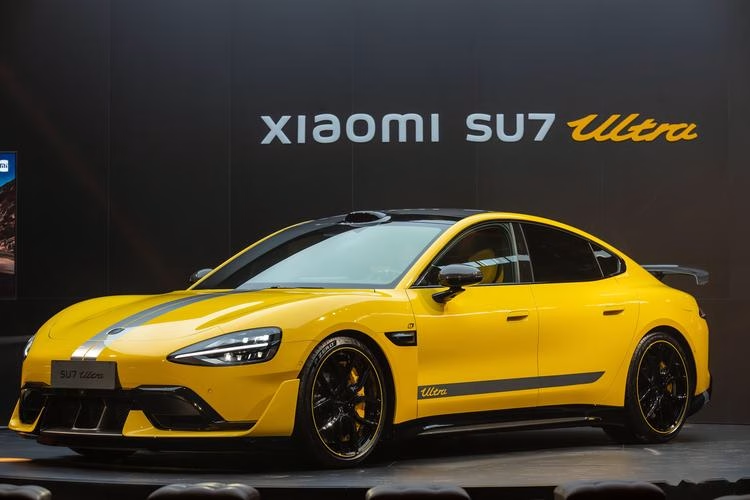
In the evolving landscape of high-performance electric vehicles, a new contender has emerged from China, challenging established norms with a blend of blistering speed, technical innovation, and unexpected affordability. The Xiaomi SU7 Ultra, the flagship sedan from tech giant Xiaomi’s automotive division, isn’t just another EV—it’s a statement. With a starting price of 529,900 yuan (approximately $73,000), it undercuts rivals by tens of thousands while delivering specs that once belonged exclusively to seven-figure supercars. After extensive testing on tracks and public roads, it’s clear: the SU7 Ultra is more than a speed demon. It’s a showcase of how Xiaomi’s tech expertise translates to four wheels.
The Numbers That Shock: Acceleration and Power
Let’s start with the headline statistic: 0-100 km/h in 2.36 seconds. That’s not a typo. During independent testing on a dry asphalt track, the SU7 Ultra’s three-motor setup—comprising two V8s and one V6s motor—unleashed 1,548 horsepower, propelling the 2,360kg sedan from a standstill to highway speeds faster than most people can blink. The acceleration isn’t just quick; it’s visceral. Seatbelts strain, heads press into headrests, and the world outside blurs into a streak—an experience that feels less like driving and more like being launched from a catapult.
But raw speed isn’t limited to the first 100 km/h. The SU7 Ultra hits 200 km/h in 5.82 seconds, and it completes the quarter-mile (400 meters) in 9.13 seconds with a trap speed of 253.25 km/h. Such figures would be impressive for a lightweight race car, let alone a five-seat sedan with a 3,000mm wheelbase. Engineers attribute this to a combination of instant electric torque, advanced torque vectoring, and a battery system that delivers 1,330kW of peak discharge power—even when charged to just 20 percent.
What’s most remarkable is how usable this power feels. Unlike some hypercars that demand perfect conditions to perform, the SU7 Ultra’s four-wheel drive and traction control system manage the chaos. Even in wet conditions, the car puts power down without excessive wheel spin, though drivers should still treat the accelerator with respect. As one test driver noted, “This isn’t a car you ‘drive’—you negotiate with it. But when it trusts you, it’s exhilarating.”
Braking: Stopping Power to Match the Speed
A car that accelerates this quickly is only as good as its ability to slow down. Here, the SU7 Ultra excels. Equipped with massive carbon-ceramic brake discs—among the largest fitted to any production car—and Akebono calipers, it delivers a 100-0 km/h stopping distance of 33.98 meters on asphalt. That’s shorter than many sports cars, let alone a full-size sedan.
But numbers don’t tell the whole story. What impressed testers was the consistency. After 10 consecutive hard stops from 160 km/h, the brakes showed no signs of fade. In fact, they performed marginally better as temperatures rose, a characteristic of high-grade carbon-ceramic components. The pedal feel is firm and progressive, giving drivers precise control—critical when navigating tight corners or avoiding obstacles.
Engineers also integrated regenerative braking into the system, which contributes up to 0.6g of deceleration. This not only extends range but also reduces wear on the mechanical brakes. In city driving, the regen can handle most slowing tasks, making one-pedal driving smooth and intuitive.
Handling: A Track-Ready Chassis in a Street Car
The SU7 Ultra isn’t just about straight-line speed. Its performance on winding roads and racetracks reveals a level of engineering sophistication that belies Xiaomi’s status as an automotive newcomer. The car’s chassis, tuned at the Nürburgring, features dual-chamber air springs and adaptive dampers that adjust stiffness and rebound in milliseconds. In “Comfort” mode, it glides over potholes and rough pavement, isolating passengers from imperfections. Flip to “Sport+,” and the suspension tightens, body roll vanishes, and the car feels glued to the tarmac.
This duality was evident during a lap of Shanghai International Circuit, where the SU7 Ultra set a new record for production cars with a time of 2:09.944—beating the Porsche Taycan Turbo GT by nearly a second. Through fast corners, the torque vectoring system shuffles power between the three motors (up to 500 times per second), braking individual wheels subtly to help the car turn in. The result is a sedan that corners like a much smaller vehicle, with understeer kept in check and a playful balance that rewards skilled drivers.
The steering is another highlight. It’s weighted perfectly—not too light for highway cruising, not too heavy for tight turns—and provides accurate feedback. At high speeds, it feels stable and planted, while in parking lots, it’s maneuverable enough for urban driving. One tester commented, “It’s like the car anticipates your moves. Turn the wheel, and it responds instantly, no lag, no fuss.”
Design: Aerodynamics Meets Aesthetic Appeal
Xiaomi’s design team walked a fine line with the SU7 Ultra: creating a car that looks fast even when standing still, while ensuring every curve serves a purpose. The result is a striking blend of aggression and elegance. At 5,115mm long, 1,970mm wide, and 1,465mm tall, it’s a large car, but its low-slung profile and wide stance give it a planted, muscular look.
Aerodynamics dictated much of the design. The front features a larger grille (10% bigger than Xiaomi’s standard models) to feed air to the radiators, flanked by U-shaped air curtains that channel airflow around the front wheels, reducing drag. The hood, made from carbon fiber, includes vents to expel hot air from the battery and motors. Along the sides, a subtle shoulder line rises toward the rear, while the sloped roofline improves airflow over the cabin.
At the back, a fixed carbon fiber rear wing and active diffuser work together to generate up to 285kg of downforce at high speeds—enough to keep the car stable at its 350 km/h top speed. The rear lights are slim and angular, spanning the width of the car, and the bumper houses large exhaust-like vents (purely cosmetic, as this is an EV) that add to the sporty aesthetic.
Inside, the focus is on driver engagement. The cabin is trimmed in Alcantara (over 5 square meters of it) and carbon fiber, with contrasting stitching in colors like “Lightning Yellow” that mirror the exterior. The seats are heavily bolstered to hold occupants during hard cornering but remain comfortable on long drives, with heating, cooling, and massage functions. The steering wheel is flat-bottomed, with a red “Boost” button front and center—pressing it unlocks maximum power for 20 seconds, a feature that elicited more than a few grins during testing.
Tech touches are everywhere, as expected from Xiaomi. A 17-inch infotainment screen dominates the dashboard, paired with a digital gauge cluster and a head-up display that projects key data (speed, battery level, navigation) onto the windshield. The system runs Xiaomi’s custom software, which integrates seamlessly with smartphones and smart home devices. For track days, a “Race Master” app displays real-time telemetry—lap times, g-forces, brake pressure—allowing drivers to analyze and improve their performance.
Range and Charging: Practicality Amidst Performance
High-performance EVs often sacrifice range for speed, but the SU7 Ultra strikes a commendable balance. Its 100kWh battery pack delivers a CLTC range of up to 630km in its most efficient configuration (without the rear wing and with low-rolling-resistance tires). Opt for the full track package, and range drops to around 520km—still enough for a weekend getaway with a few detours.
Charging is where the SU7 Ultra truly stands out. It supports 5.2C fast charging, meaning it can go from 10% to 80% in just 12 minutes when connected to a compatible charger. During testing, we plugged in at a 480kW station and watched the battery jump from 20% to 75% in 10 minutes—enough to add 300km of range. For context, that’s roughly the time it takes to grab a coffee and a snack.
The battery itself is a marvel of engineering. Co-developed with CATL, it uses “bulletproof coating” technology to resist punctures and extreme temperatures, and it features dual cooling systems to handle the heat generated during high-speed driving. In one grueling test, the car completed 10 consecutive lap records at a race track, and the battery temperature never exceeded safe limits—a testament to its thermal management.
Who Is This Car For?
The SU7 Ultra’s 529,900 yuan starting price positions it against the Tesla Model S Plaid and Porsche Taycan, but its performance and features make it a compelling alternative. It’s not for everyone, though. The sheer power demands respect; this isn’t a car for new drivers. Xiaomi acknowledges this with a “Novice Mode” that limits speed to 140 km/h and disables certain performance features until the car has been driven 300km, giving owners time to acclimate.
Instead, it’s aimed at two groups: enthusiasts who want a track-capable car they can also use daily, and luxury buyers looking to trade their German sedans for something more exciting. Early sales data supports this—80-90% of buyers are coming from brands like BMW, Mercedes, and Porsche, with many trading in models like the 5 Series and E-Class.
One such buyer, a former Porsche 911 owner, summed it up: “I wanted something that could keep up with my 911 on a track but had room for my family and groceries. This does both, and it’s cheaper to run. The fact that it’s a Xiaomi—with all the tech integration—was just a bonus.”
The Verdict: A Game-Changer for Chinese EVs
The SU7 Ultra is more than a car; it’s a statement. In little over a year since entering the automotive market, Xiaomi has delivered a vehicle that challenges the best from Europe and America, not just on performance but on refinement, technology, and value.
Critics will point out that Xiaomi is new to cars, questioning long-term reliability. Only time will answer that, but early signs are positive. The SU7 Ultra underwent rigorous testing—from the freezing temperatures of Heilongjiang to the 45°C heat of Xinjiang—and its components are sourced from established suppliers (CATL for batteries, Akebono for brakes).
For drivers who can handle its power, the SU7 Ultra is a revelation. It’s fast, yes, but it’s also comfortable, practical, and packed with smart features. It proves that electric cars can be thrilling without being impractical, and that Chinese automakers are no longer content to play second fiddle.
As one tester put it after a day on the track: “This car doesn’t just raise the bar for Chinese EVs. It raises the bar for all performance cars. Porsche, Tesla—they need to step up. Xiaomi isn’t here to participate. It’s here to dominate.”
In the end, the SU7 Ultra’s legacy may not be its 2.36-second sprint or its Nürburgring record. It may be that it showed the world what’s possible when a tech company with a “user-first” mindset turns its attention to cars: a vehicle that’s as innovative as it is exhilarating, and as accessible as it is aspirational. For that alone, it deserves every bit of the hype.